DATE: 2026/07/21
SEER Robotics Co-founder Ye Yangsheng: To Advance Steadily and Far, Embodied AI Must First Enter the Real World
During the 2026 World Artificial Intelligence Conference (WAIC), Yicai Media launched its 4×24 LIVE series.
Ye Yangsheng, Co-founder of SEER Robotics, was invited to join the roundtable discussion titled "How Can Embodied AI Advance Steadily and Far?" Together with fellow panelists, he explored the development path of the embodied AI industry and examined the challenges and opportunities that lie ahead as the sector moves from technological breakthroughs toward large-scale deployment.
Robots Truly Grow in the Real World
Addressing the ongoing industry debate over the mix of impressive demonstrations and high-profile missteps in humanoid robots, Ye argued that what truly deserves attention is not the occasional stumble, but whether the industry is continuing to move in the right direction.
"What many people see are humanoid robots stumbling; what the industry sees is robots finally beginning to enter the real world," he said. In his view, a robot is an extraordinarily complex system. From the hardware platform and core components to control algorithms, environmental perception, and supply chain maturity, every link requires continuous evolution.

Even today, robots continue to encounter challenges in factories, warehouses, and even home environments. This is both an objective law of technological progress and a stage the industry must pass through on its path to maturity.
Ye drew a parallel with the automotive industry: just as automobiles evolved from experimental prototypes to mass deployment, robotics must go through the same journey. What truly drives the industry forward is not a single successful demonstration, but an ever-growing number of robots entering real scenarios, iterating and maturing through actual work.
The Next Breakthrough in Embodied AI Depends on Real-World Scenarios and Real-Robot Data
This observation leads to another of his core judgments on the development of embodied AI.
In recent years, the rapid advance of large models has been driven largely by continuous training on massive volumes of internet data. For embodied AI, however, the truly scarce resource is not models, but real-world data.
"The brain of embodied AI has not yet had its GPT moment. A major reason is that we still lack sufficiently rich real-world scenarios and real-world data," Ye stated at the event.
In his view, for robots to truly acquire generalization capabilities, they must first enter the real world.
Only by entering factories, warehouses, logistics operations, commercial services, and a wider range of real production and daily-life scenarios can robots continuously complete tasks, accumulate experience, and generate large volumes of rea
l-world operational data. This real-robot data will not only continuously refine robots' control capabilities but also train increasingly intelligent, more generalizable embodied AI brains.
This has long been the technology path to which SEER Robotics' founding team has remained committed.
From the very beginning, rather than pursuing the robot hardware platforms that more easily attract the spotlight, the team chose to focus on building foundational capabilities such as the robot brain, control systems, and multi-robot coordination. In his view, what determines a robot's long-term competitiveness is not the ability to pull off a single impressive maneuver, but the continuous improvement of its ability to solve problems in the real world.
Building Embodied Infrastructure Starts with Large-Scale Deployment
Building on this philosophy, Ye further argued that large-scale deployment is not merely a commercial outcome, but a prerequisite for the continuous evolution of embodied AI.
The more robots are deployed, the richer the real-world scenarios they enter, and the more real-robot data they generate; the richer the real-robot data, the stronger the generalization capability of embodied AI models; and stronger generalization, in turn, propels robots into more industries and scenarios, creating a virtuous cycle of continuous evolution.
This is precisely the direction SEER Robotics has been advancing in recent years.
Leveraging its robot brain, open platform, and multi-form robot products, SEER Robotics continues to drive large-scale deployment of robots across an expanding set of real-world scenarios. By continuously accumulating high-quality real-robot data, the company is strengthening the generalization capabilities of embodied AI and further building the embodied infrastructure for the future.
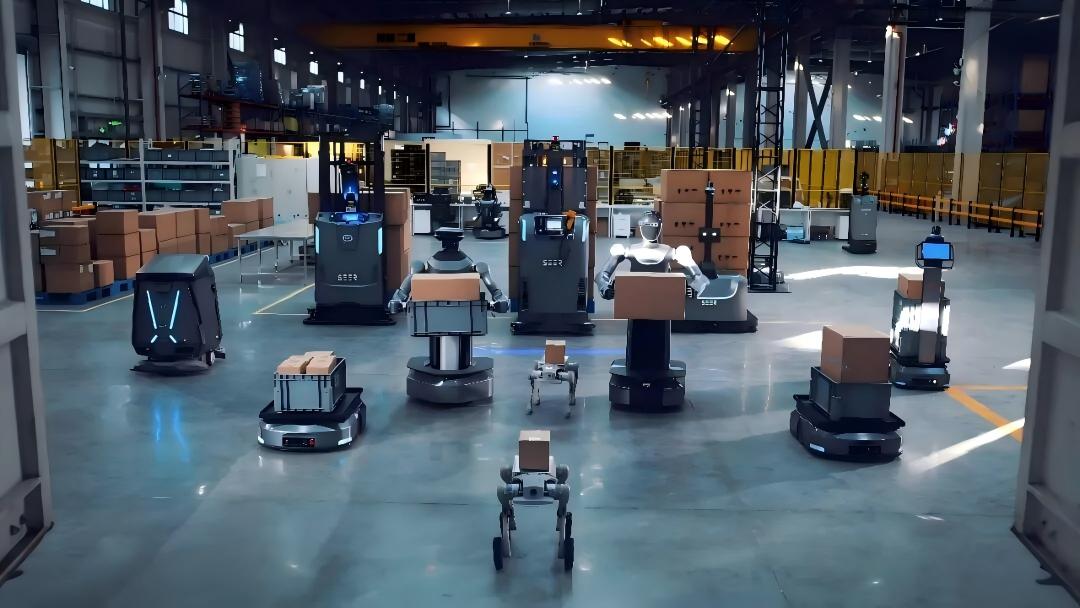
In Ye's view, the real competition in embodied AI will not take place on the exhibition stage, but in the real world.
Likewise, what will determine robot capabilities in the future is not a single brilliant demonstration, but the tasks completed day after day in real scenarios. Only when more and more robots can reliably enter production and daily life, continuously learning and growing, will embodied AI truly move toward large-scale application—and truly deliver steady, far-reaching progress.


/1.png?x-oss-process=image/format,webp)
/1.png?x-oss-process=image/format,webp)
 Contact Us