
DATE: 2026/05/06
SEER Robotics Insights | Does Embodied Intelligence Necessarily Mean Humanoid Robots?
As embodied intelligence becomes a major focus of both policy and capital investment, humanoid robots are increasingly dominating technology headlines under labels such as “the ultimate form of embodied AI.” Alongside this trend, a growing industry misconception is also being amplified:
Many people now assume that embodied intelligence is synonymous with humanoid robots, and that only anthropomorphic bipedal robots represent the “true” form of embodied AI.
But is that really the case?
The answer is no.
Humanoid robots have never represented the entirety of embodied intelligence, nor are they the only pathway toward it. Clarifying this fundamental understanding is essential for truly recognizing the technical nature, industrial roadmap, and future direction of embodied intelligence.
I. Returning to Fundamentals: What Is Embodied Intelligence?
To move beyond the industry’s growing “humanoid fixation,” we must first return to the core definition of embodied intelligence.
Embodied AI represents the expansion of artificial intelligence from the digital world into the physical world. At its core, it uses AI foundation models as the software backbone, embedding intelligence into physical hardware systems to achieve real-time interaction and autonomous evolution through a complete closed loop of:
environmental perception → autonomous decision-making → physical execution → feedback-driven iteration
Put simply, large language models and multimodal models belong to the category of “disembodied intelligence.” They process information and generate outputs within virtual digital environments, functioning as highly capable “thinkers” that remain disconnected from physical reality.
Embodied intelligence, by contrast, transforms AI into a “doer” capable of entering the real world. Through physical hardware systems that can “see,” “hear,” and “act,” embodied AI converts AI reasoning into practical physical-world actions.
Two essential characteristics immediately break the misconception that embodied intelligence must equal humanoid robots.
1. The Core Criterion Is AI Capability
The true technological essence of embodied intelligence lies in AI capability itself: machine perception, understanding, reasoning, decision-making, autonomous learning, and adaptive interaction.
What we often refer to as the “robot brain” is jointly built upon data-driven AI models and control systems. A standalone large model alone cannot truly deliver a deployable embodied intelligence brain.
2. Embodiment Has No Single Form Factor
The physical carriers of embodied intelligence are not limited to humanoid structures.
Different robotic forms possess different advantages. As long as a system is driven by AI models and capable of establishing a closed-loop interaction with the physical world, it represents a valid embodiment of embodied intelligence.
SEER Robotics has gained deep practical insight into this through real-world embodied intelligence deployment.
Embodied intelligence is not a concept defined only by a distant end state. It is a progressive process in which AI capabilities continuously unlock value across different physical platforms.
What determines this process is not only the model itself, but also the hardware platform, data availability, scenario complexity, and customer value realization.
Based on this understanding, SEER Robotics believes embodied intelligence can be broadly divided into three stages.
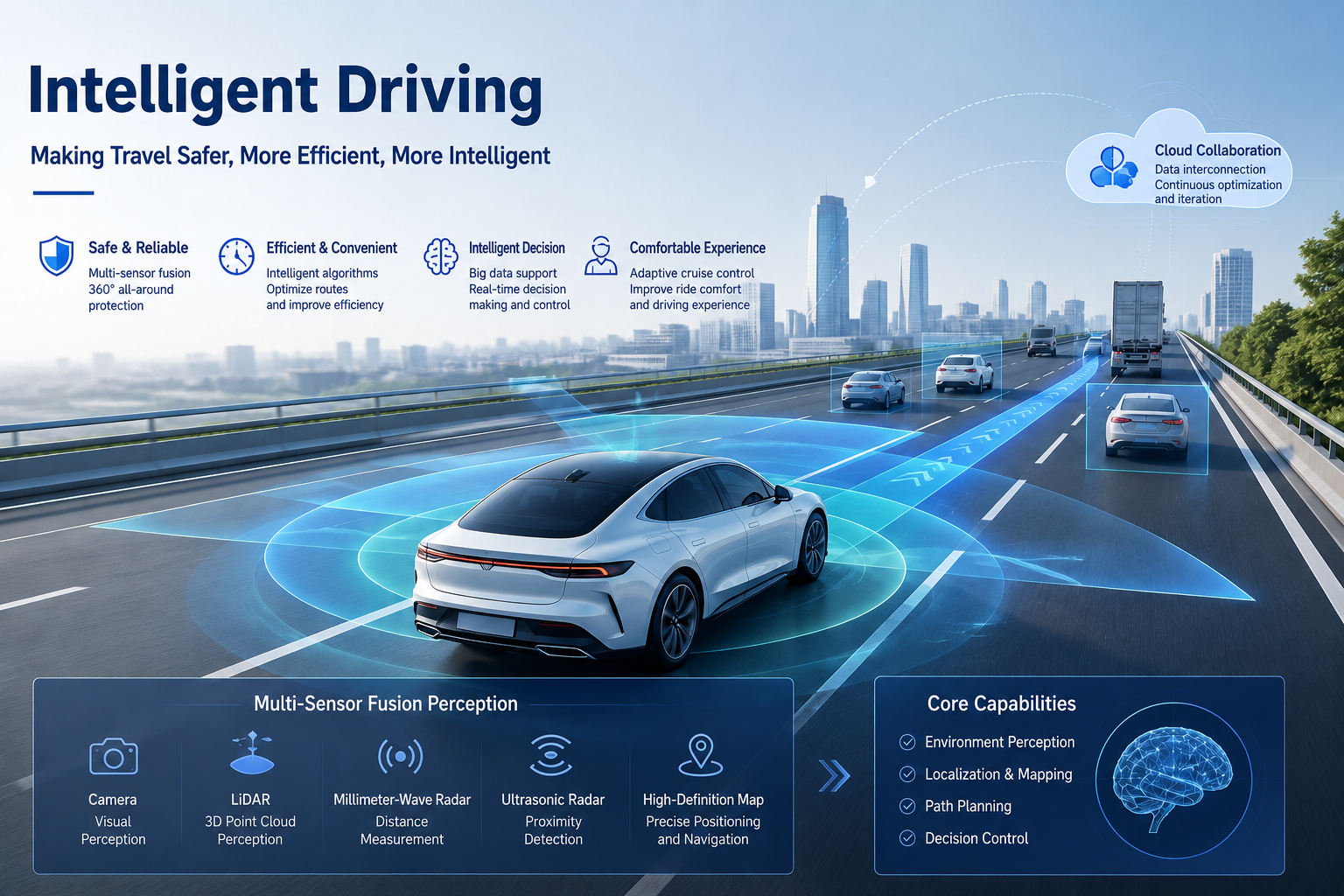
Stage One: Autonomous Vehicles — Solving the Initial Challenge of “Mobility”
At this stage, the hardware platform—the vehicle itself—is already mature.
The primary focus is leveraging real-world sensory data, particularly vision, to solve one core challenge:
How to enable machines to move reliably in the physical world.
The key value of this phase includes:
- Validating the feasibility of the embodied AI closed loop of perception, decision-making, and execution
- Accumulating massive volumes of real-world interaction data
- Advancing core technologies such as multimodal perception and real-time decision-making
Stage Two: Embodied Intelligent Robots — Solving “Mobility + Light Manipulation + Intelligent Interaction”
At this stage, the hardware platforms are also relatively mature, and the underlying data and technical paradigms closely resemble those used in autonomous driving.
The difference is that robots move one step beyond pure mobility, entering real industrial scenarios that require light manipulation and intelligent interaction.
This is precisely the stage SEER Robotics is currently focused on.
Platforms combining mobility with light operational capabilities have already undergone extensive market validation and are becoming increasingly mature. Examples include intelligent forklifts, mobile robots, and composite robotic systems.
These platforms typically involve limited degrees of freedom and do not require dexterous hands, highly delicate manipulation, or extremely complex multimodal training data.
The core value of this stage lies in:
- Controllable technical risk
- Faster deployment cycles
- Strong cost advantages and scalability
- Rapid validation of embodied intelligence in real industrial environments
Stage Three: General-Purpose Humanoid Robots — Solving “Mobility + Dexterous Manipulation + Intelligent Interaction”
This represents a more advanced long-term vision for embodied intelligence.
However, today it still depends on hardware platforms, multimodal physical data, and technological paradigms that remain insufficiently mature.
Humanoid robots are indeed the “crown jewel” of embodied intelligence—but they are neither the starting point nor the entirety of embodied AI.
The industry must respect the objective laws of technological evolution: beginning with deployable, high-value scenarios and gradually advancing toward more sophisticated forms.
II. Scenarios Determine Form Factors
The essence of embodied intelligence lies in the coordination between “body” and “intelligence”—not whether the body resembles a human being.
Through its strategy of integrating established industrial technologies with next-generation AI capabilities, SEER Robotics is exploring a diversified pathway for embodied AI deployment.
Different robotic forms excel in different scenarios:
- Wheeled robots: High efficiency, strong stability, and low energy consumption in structured environments
- Legged robots: Exceptional adaptability in complex terrain
- Specialized robots: Optimal efficiency and cost performance in dedicated industrial applications
For example:
- On manufacturing lines, specialized robotic systems significantly outperform humanoid robots in efficiency, stability, and cost control
- In mining or oil and gas pipeline inspection, tracked robots possess environmental adaptability far superior to bipedal humanoid structures
- In home cleaning scenarios, robotic vacuum cleaners have already achieved practical large-scale deployment—far beyond the current maturity level of humanoid robots still in experimental phases
III. The Future of Embodied Intelligence Will Never Belong to a Single Form Factor
Across the industry, one major trend is becoming increasingly clear:
Embodied intelligence is moving away from the hype of “blind anthropomorphism” and shifting decisively toward practical, scenario-driven deployment.
The ultimate mission of embodied intelligence has never been to create robots that look exactly like humans.
Its true mission is to bring AI out of the digital world and into real industries—solving practical challenges across countless sectors.
Form factors will always serve scenarios.
Intelligence remains the true core.
This is the foundational logic driving the embodied intelligence industry forward.
IV. Conclusion
Returning to the original question:
Does embodied intelligence necessarily mean humanoid robots?
SEER Robotics’ answer is clear:
Humanoid robots can certainly represent embodied intelligence—but embodied intelligence is far more than humanoid robots alone.
True embodied intelligence means:
Scenarios determine form factors. Technology empowers intelligence.
Regardless of a robot’s physical structure, any system capable of efficiently perceiving and interacting with the physical world represents a valuable embodiment of embodied AI.
Looking ahead, SEER Robotics will continue advancing core technologies, expanding ecosystem collaboration, and supporting the deployment of increasingly diverse forms of embodied intelligence.
Together, we will continue exploring the limitless possibilities of embodied AI and advancing the mission of:
SEER Robotics, All Robots. One Platform. Fully in Your Control


/1.png?x-oss-process=image/format,webp)
/1.png?x-oss-process=image/format,webp)
 Contact Us