
DATE: 2026/07/21
SEER Robotics at WAIC 2026: Building Embodied Infrastructure for Real-World Intelligent Systems
While previous editions of WAIC centered on the relentless breakthroughs in AI model capabilities, a more defined trend has taken shape this year: artificial intelligence is accelerating its entry into the physical world, and embodied intelligence has emerged as a critical pathway connecting AI technology with industrial applications.
This shift lends this year's WAIC added significance. From models to robots, from computing power to industrial deployment, a growing number of companies are showcasing the foundational capabilities that enable AI to operate in real-world scenarios—moving beyond isolated technical demonstrations.
Over four days, across two venues and three booths, visitor traffic remained continuous.
SEER Robotics showcased humanoid robots, a humanoid robot chassis, and the AI delivery robot P300 at three partner booths located at Zhangjiang Science Hall and the World Expo Exhibition & Convention Center.
Though the three booths appeared to cover different products and use cases, they all converged on one objective: accelerating the development of embodied infrastructure.
From Demonstration to Real Work: Humanoid Robots in Real-World Applications
At booth Z1B-407 in Haike Hall, Zhangjiang Science Hall, SEER Robotics set up an embodied service zone where an interactive humanoid robot beverage delivery experience drew steady crowds. Some visitors repeatedly tested the robot's ability to grasp different drinks, others observed its manipulation motions at close range, and many engaged in detailed discussions with on-site engineers about embodied intelligence applications.
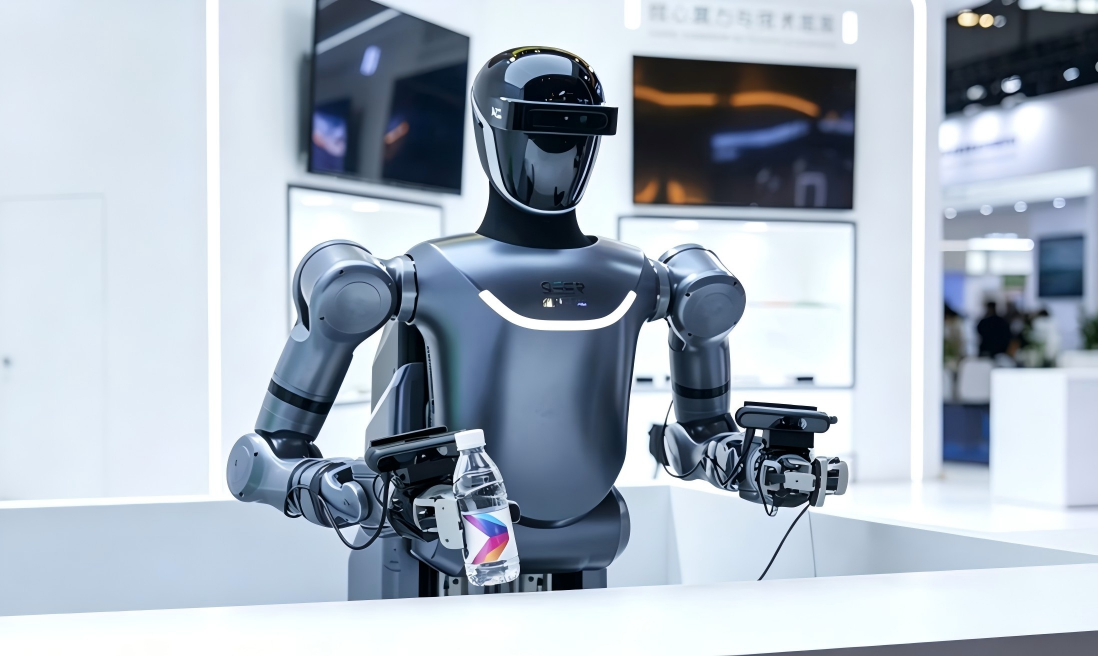
Rather than presenting pre-programmed motion routines, this interactive experience closely mirrored an actual service environment, offering a tangible demonstration of the humanoid robot's capacity to autonomously understand, plan, and execute tasks. Throughout the interaction, the robot completed a full closed loop spanning task comprehension, visual recognition, motion planning, and execution feedback.
Underpinning this performance is SEER Robotics' continuously maturing embodied intelligence capability stack.
Leveraging a Vision-Language-Action (VLA) model, the humanoid robot fuses visual perception, language understanding, and motion control, enabling it to autonomously interpret user instructions and execute tasks in continuous sequences.
Combined with hand-eye-foot coordination and impedance control technologies, the robot maintains stable manipulation while in motion and delivers more natural, safer human-robot interaction.
Additionally, SEER Robotics' humanoid robots possess strong generalization capabilities. When presented with new SKUs or previously unseen task scenarios, only a minimal number of training samples are required, substantially reducing deployment and secondary development costs.
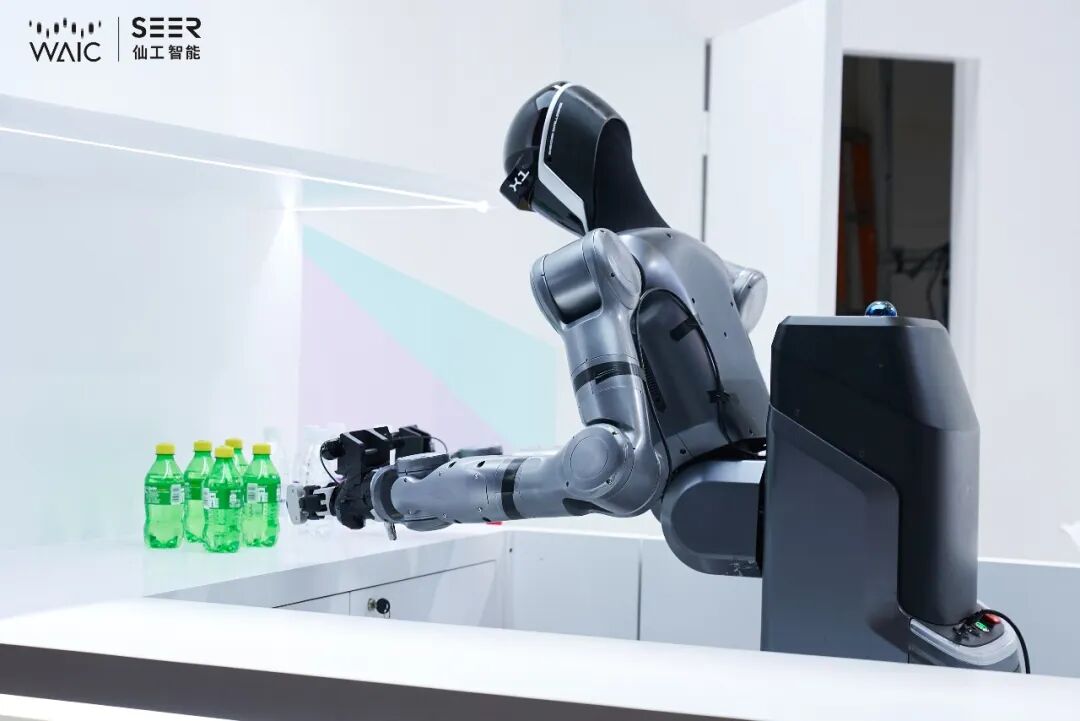
All of these capabilities rest on the continuous accumulation of real-world data.
Drawing on an installed base of over 50,000 robot controllers and more than 500,000 cumulative hours of multi-form real-robot data, SEER Robotics has built a data closed loop encompassing data collection, model training, deployment validation, and continuous optimization. As the installed base expands, real-world data will continue to fuel a virtuous cycle, providing sustained momentum for the iterative advancement of embodied intelligence models.
Expanded Embodied AI Product Portfolio Targets Industrial Deployment
While the humanoid robots attracted considerable attention from exhibition visitors, many partners and industry customers directed their focus toward how robots can genuinely enter production environments.
Ongoing conversations at the booth addressed humanoid robot development, deployment, control architectures, and open interfaces.
The wheeled humanoid robot chassis on display is more than a mobile base—it serves as a foundational platform that SEER Robotics has engineered specifically for embodied intelligence.
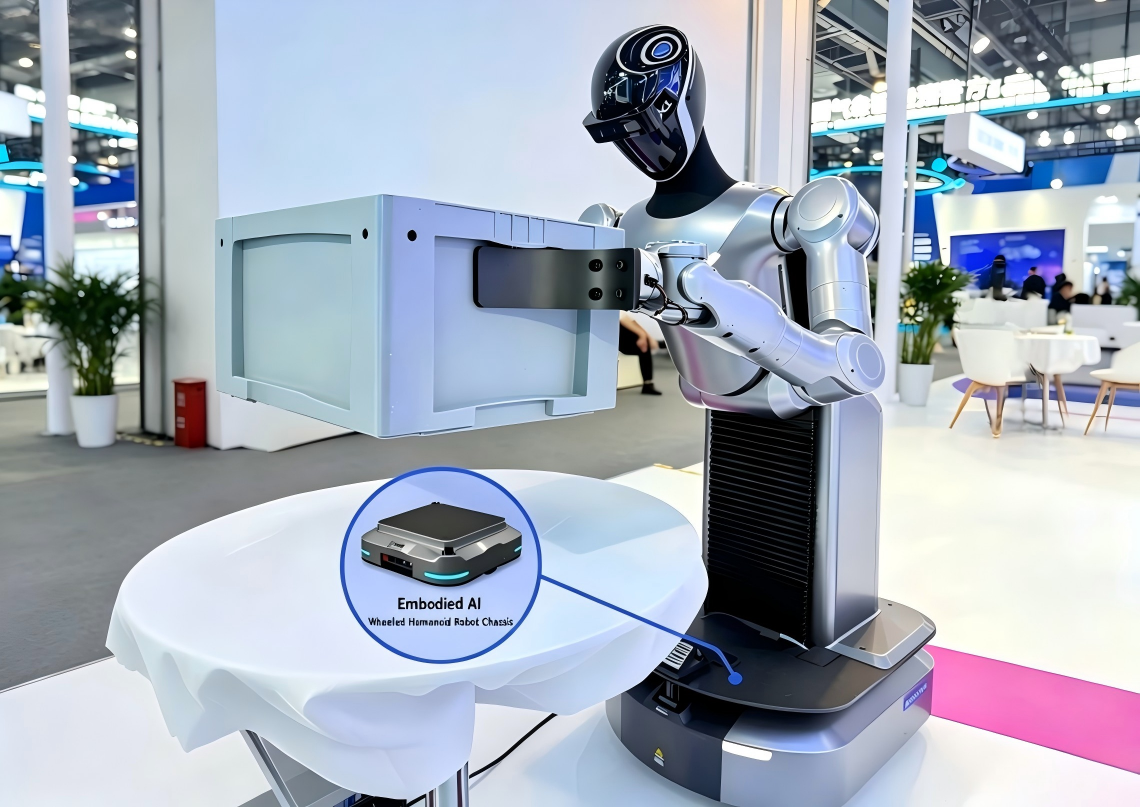
As a purpose-built base platform for humanoid robots, the chassis features a modular design compatible with various upper-body configurations, offering developers a more open framework for humanoid robot development.
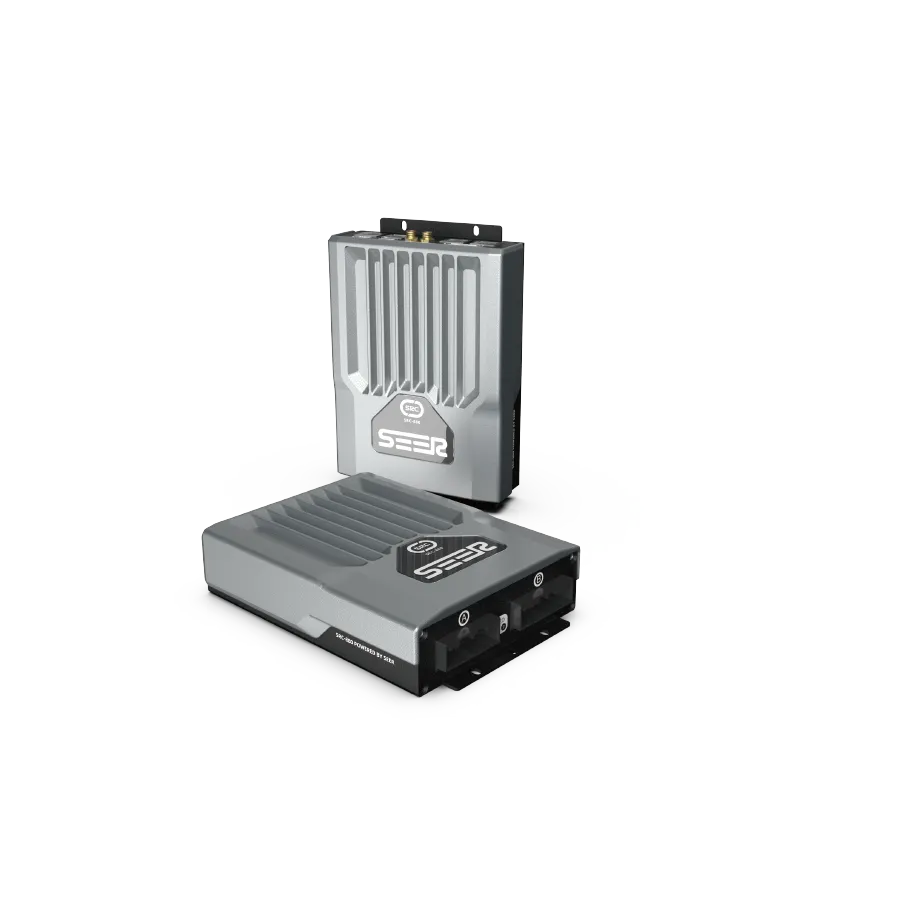
Equipped with SEER Robotics' proprietary SRC-4000 robot controller and compatible with the M4 intelligent robot management system, the chassis delivers integrated control, fleet scheduling, and coordinated operation, providing reliable support for large-scale humanoid robot deployment.
If the humanoid robot chassis addresses the need for stable robot operation, the AI delivery robot P300 answers the further question of how AI can accelerate time-to-deployment.
At the show, the P300 drew significant interest from industry attendees. Unlike conventional automation equipment that entails lengthy deployment cycles and complex implementation, the P300 is designed to be deployed out of the box and operational for delivery immediately. Basic configuration can be completed in as little as 10 minutes before delivery tasks commence—no facility modifications or on-premise server deployment required—enabling enterprises to validate automation at a lower barrier and within a shorter timeframe.
Beyond being an AI delivery robot, the P300 reflects SEER Robotics' sustained efforts to drive the standardization, productization, and scalable adoption of robotic capabilities, allowing AI to empower robots in real industrial settings more rapidly.
WAIC 2026: Products on Display, Embodied Infrastructure Under Construction
Over the four-day exhibition, SEER Robotics presented not merely a portfolio of embodied intelligence products, but a concentrated demonstration of its progress in building embodied infrastructure.
Throughout the event, SEER Robotics engaged in continuous dialogue with industry partners on the trajectory of embodied intelligence, real-world data accumulation, large-scale robot deployment, and open ecosystem development. These exchanges reinforced a clear conviction: the future competitive landscape in robotics will not be defined by models alone, but by the embodied infrastructure that enables models to run, learn, and evolve continuously.
As AI increasingly permeates the physical world, industry competition is extending from model capabilities toward foundational infrastructure. Robots require not only continuous learning but also stable control, open platforms, real-world data, and a robust industrial ecosystem.
Historically, SEER Robotics established unified robot control through its robot controllers; subsequently, it connected robots, developers, and the industrial ecosystem via an open platform; today, it is further developing the underlying capabilities for real-world intelligent systems, advancing the construction of embodied infrastructure.
For SEER Robotics, embodied infrastructure is not a single product but an integrated system of foundational capabilities that enables continuous learning, coordinated operation, and large-scale deployment of robots.
Looking ahead, SEER Robotics will continue to collaborate with global ecosystem partners to advance the infrastructure required for real-world intelligent systems, enabling more robots to share a unified controller, an open platform, and a continuously evolving capability foundation—accelerating the adoption of embodied intelligence across an ever-wider range of industrial applications.


/1.png?x-oss-process=image/format,webp)
/1.png?x-oss-process=image/format,webp)
 Contact Us