
DATE: 2026/08/03
Exclusive 4-Hour Interview with Zhao Yue, Founder of SEER Robotics: The Next Battlefield in Embodied Intelligence — Real-World Robot Data
The following article is from Wei Shijie - Light the Star, by Wei Shijie.
This is my favorite founder interview of the year so far.
Chatting with Zhao Yue was fascinating — before I knew it, he had spent a full 90 minutes talking about RoboCup, the "World Cup of Robotics." You could see the spark in his eyes.
In 2016, a "chubby kid" from Zhejiang University's Chu Kochen Honors College, who practically lived in the lab — a nobody, or "xiaokalami" (small fry) as he calls himself — led his team to defeat CMU (Carnegie Mellon University), the world's strongest robotics lab, securing China's first-ever RoboCup global championship. This was the starting point of SEER Robotics' dream, and its deepest DNA: a love of toppling giants.
But this is not merely a "nostalgia" story.
Though it may be a dream from a previous era, the engineering philosophy, systematic thinking, and pragmatic spirit behind competitive robotics remain the soul of today's embodied intelligence battle.
Over the past two years, I've heard many innovative ideas from the new wave of embodied intelligence startups. By and large, both capital and entrepreneurial narratives focus on the embodied brain model layer — building a universal, generalizable brain for embodied robots is currently the hottest and most capital-favored entrepreneurial direction.
But Zhao Yue offers several disruptive industry judgments:
1、On the B2B side, there will be no true robotics (hardware) giant — a rather provocative statement for the many companies currently obsessed with building hardware and rushing to deploy robots in factories.
2、In the future, data will be roughly equivalent to models — all battles will be fought around data, and companies that own data will be invincible.
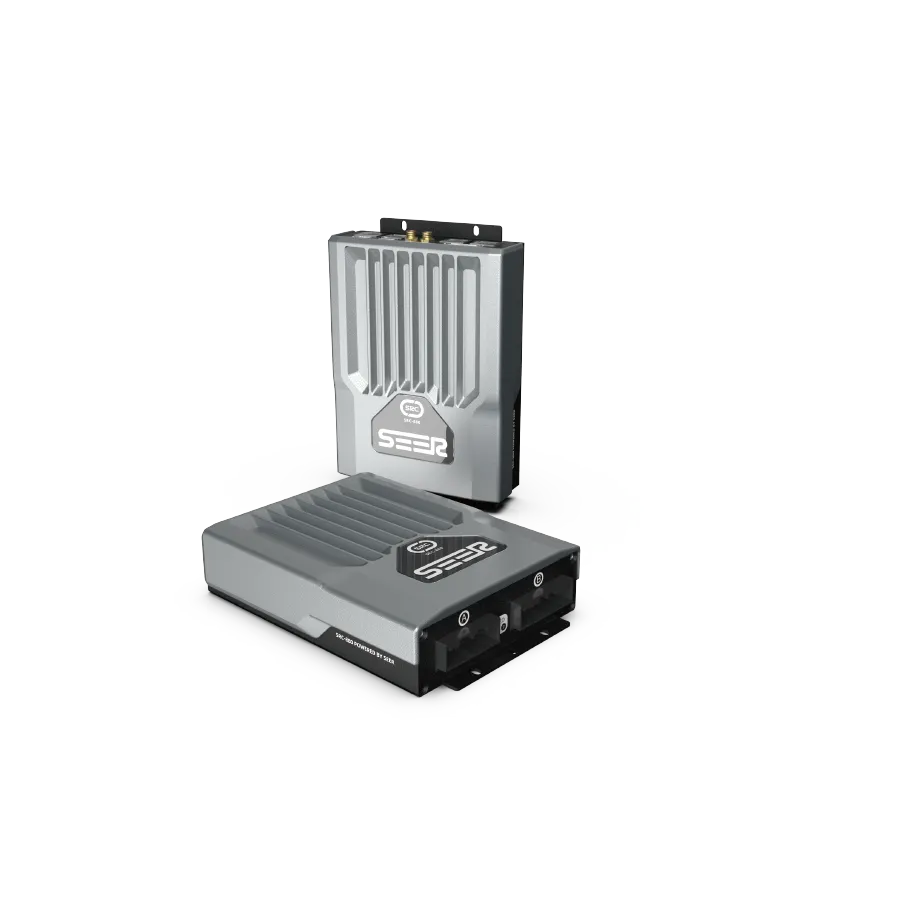
After his first startup failed, Zhao Yue learned the lesson from day one: don't build robots, focus on the controllers they need. In 2023, SEER Robotics became the global number one in intelligent robot controllers, has retained that position ever since, and continued to widen its market share lead in 2025.
I've long noticed this hidden champion. What's surprising is that the company isn't chasing flashy growth — it's quietly shifting its chips for the embodied intelligence era. Through controllers and a unified toolchain, companies like SEER Robotics have the opportunity to acquire high-quality data in specific embodied scenarios more quickly. That's precisely the challenge many of this generation's startups will face in the coming years.
But what truly sets this interview apart is the extremely rare "anti-performative" authenticity Zhao Yue embodies in today's business narratives — I barely sensed any defensiveness from him. He is profoundly rational, candid, and relaxed, and behind that lies profound self-consistency. Listeners can feel how that self-consistency was forged through the stories of his life journey.
(We invite you to watch the video version for a more vivid sense of the humor, warmth, and ease that the written word cannot capture. Search "Wei Shijie Light the Star" on any platform for the episode: "The First Listed Robotics Brain Company — A 4-Hour Interview with Zhao Yue of SEER Robotics.")
Finally, there is consistency. When a person's actions repeatedly align with their deepest thinking logic and worldview, that discovery is nothing short of delightful for a documentarian.
At the beginning of the interview, Zhao Yue said, "The one who fires the gun must have theawareness (awareness) of being shot." At the end, he told the story of Code Geass: Lelouch of the Rebellion — a world divided, and the protagonist who sacrifices himself to unify it. This mirrors the philosophy behind "striving to be number one" that we discussed repeatedly: the moment you become number one, "number one" ceases to exist.
In short, I highly recommend this interview. It offers not only fresh perspectives on the industry's evolutionary path and the inner journey of a hidden champion, but also the history of robotics, human passion, and philosophically rich thinking.
This world needs both idealists with soaring spirits and sober, pragmatic builders.
Slime: The Weakest Yet Most Formidable Little Monster!
Wei Shijie: Do people at the company call you "Yue Ge" (Brother Yue)?
Zhao Yue: Mostly, about 90% of them. Newcomers might call me "Mr. Zhao" at first, but after about a week, they're basically all calling me Yue Ge.
Wei Shijie: I get the sense they really like you. When I visited last time, I noticed your company mascot looks a lot like Jigglypuff. And they told me it's probably because you're a bit on the heavier side — that Jigglypuff resembles you.
Zhao Yue: It's not Jigglypuff. It's a little slime. You know, from the Dragon Quest games — the weakest little monster. It's so weak you can kill one with a single strike, but then again, it can also be incredibly strong — it might kill you with one hit too.
We used it as our logo for two reasons. First, the team was pretty young and everyone played games. Slime — there was this terrible pun back then, because we were working on SLAM (Simultaneous Localization and Mapping). SLAM sounds like "slime" in Chinese. Probably only we thought that was funny (laughs).
Second, slime is like a blob of clay — it can take all kinds of forms. It symbolizes how we can provide systems for all kinds of robots, morphing into all sorts of functions.
Wei Shijie: It's very rare for a tech company to use a cartoon character as a mascot.
Zhao Yue: Is that right? Okay then.
Wei Shijie: It's quite interesting — people walking by might think it's an animation company.
Zhao Yue: Could be.
Wei Shijie: That slime monster vibe. It reminds me of your journey as student entrepreneurs.
Zhao Yue: Yeah, coming from our student days, it's been pretty much that same process: starting out as total nobodies, then getting into competitions, doing RoboCup, and gradually growing into... (Wei Shijie: a big boss?) Yeah, and then somewhere along the way, boom — we won the world championship.
Wei Shijie: So you admit you're a big boss now.
Zhao Yue: (laughs) Don't become a big boss. If you become a big boss, someone might come along andwipe out you.
Wei Shijie: When do you think SEER Robotics turned from a nobody into a boss? What was the turning point?
Zhao Yue: Maybe we've just always had a good mindset. We've never thought of ourselves as big bosses. For customer requests that seem bizarre or are corner cases — the kind some manufacturers might look down on — we still take them very seriously. Our company is highly inclusive. Our mission is "Drive a more open, diverse era of intelligence, making AI robots accessible to all." If you want to create such a diverse world, you first can't be too limited yourself. We're very inclusive — to the point of almost having no values at all.
Wei Shijie: I feel like there are a lot of contrasts in you. There's the inclusive, easygoing, "nobody" side. But I also sense something sharp and rebellious inside — a desire to flip the table.
Zhao Yue: Yeah, always seeing myself as a nobody, always wanting to flip the table. That's roughly the inner state. You could call it youthful spirit, or less charitably, maybe a bit arrogant.
Wei Shijie: When do you check yourself for arrogance?
Zhao Yue: I need to think about that... Sometimes it's all a bit chaotic inside. Whether something is good or bad, arrogant or humble — it's not always clearly separated.
Wei Shijie: I loved what you said when you walked in earlier: the long stretch between wrong and right is chaos. You have to walk through it, and when you look back, you realize it's become right. (Note: Before the interview, Zhao Yue showed me a cultural wall in the office — from the left it reads "wrong," from the right it reads "right.")
Zhao Yue: Exactly. Things are dynamically changing, and often you shouldn't rush to judge them. So we ended up putting right and wrong together on the wall.
RoboCup World Championship: In the Robotics Pyramid, Solve at the Bottom Layer Whenever Possible — Don't Push It Upstairs
Wei Shijie: During your graduate studies, you did something remarkable: you dropped out after five years of medical school? (Note: The full story of Zhao Yue's RoboCup experience at Zhejiang University's Chu Kochen Honors College is fascinating — check out the original video podcast.)
Zhao Yue: Looking back, it wasn't that big a deal. At Zhejiang University's Chu Kochen Honors College, there was this fascinating program — the eight-year medical track. The idea was great: China doesn't lack good clinicians or good medical professors. What it lacks is clinician-scientists. Academician Ba Denian's logic was that you need to bring clinical problems back, research them, and then feed the results back into clinical practice to form a bigger closed loop.
So students needed a broader foundation. You had to be able to discover more problems, and a prerequisite for that was understanding the world better. For the first four years, we were required to study a non-medical undergraduate major — so I picked Zhejiang University's most famous one, Electronic Information Engineering. To earn extra credits, I started competing in RoboCup. Initially, it was purely for the credits.
(Note: RoboCup, the Robot World Cup, is a top global academic and robotics competition centered on AI and robotics technology. Its most famous vision: by 2050, develop a fully autonomous humanoid robot soccer team that can defeat the human World Cup champion team.)
Back then, we had two campuses. The medical school was at Zijingang, and the RoboCup lab was at Yuquan. So I studied medicine during the day and worked on the competition at night, shuttling back and forth.
Medicine and engineering require completely different ways of thinking. It was quite a split personality. But I personally preferred the logic of electronic engineering — you could verify things quickly. I just wasn't that interested in the experimental side of medicine. Since I couldn't switch majors, I dropped out and retook the college entrance exam.
Wei Shijie: I heard you basically lived in the lab during competitions — you didn't even know your roommates?
Zhao Yue: Yeah, undergrad was manageable, but grad school got extreme. The lab had carpet on the floor, so you could just lie down and sleep. No need to go back to the dorm. Tune robots during the day, sleep there at night.
Wei Shijie: When did you realize robotics was something you really enjoyed?
Zhao Yue: It wasn't so much about enjoyment — it was about a moment when I knew I had to keep doing this. In 2009, we faced Dalian University of Technology in the finals, and we got crushed — 0:2 or 0:3, something like that.
I had just joined the lab and was still a total nobody. I was the guy who picked up the wheels when robots crashed and lost them. In competitions, they call that role the "Picker."
I was pretty heavy back then, so every time I ran out onto the field, the floor would shake — boom, boom, boom. Every time I went out there, the opponents would say, "Hey, chubby kid, don't run so fast on the field. The cameras are shaking, the picture isn't stable!"
Yeah, that was my role. And to top it off, we lost badly. So I thought, damn it, next time I'm going to get them back! You know that feeling? So I put more effort into it. A year later, we beat Dalian University of Technology 5:0. Wow. That felt amazing.
And then there was this constant positive feedback — you move forward, run into a mini-boss that smacks you down. Then you go level up, get better gear, come back and beat it, then move on. It was just like that, over and over. Pretty fun, actually — a lot like playing a game.
Wei Shijie: And you kept going all the way to the world championship. China's first title, right?
Zhao Yue: Yeah, basically you go from campus competition, to national competition, to world competition.
Wei Shijie: You got into Zhejiang University without breaking a sweat, you wanted a second major in the top school and you got it. You casually entered a competition and became world champion — after so many surprising coincidences in life, do you ever revalue yourself and think, hey, maybe I'm actually someone special?
Zhao Yue: No. Looking back now, there were far more problems than the final championship moment would suggest.
When I first joined the lab, it took about a year before I even got to touch a robot — because the lab didn't even have robots. The university had this big project, and all the people and robots werededicated to that project.
So we started recruiting people on the BBS forum. But you find that the ones who stay are usually the ones who genuinely love it. It's a lot like entrepreneurship — the ones who succeed aren't necessarily the strongest people, but the most passionate. When we started hiring at the company, everyone was a nobody at first, but they all ended up becoming really good.
Wei Shijie: What are the similarities between training robots for RoboCup and training embodied robots today?
Zhao Yue: Back then, we did opponent prediction, which is a lot like the training methods everyone uses now — we'd collect log data from competitors' matches. We'd either write algorithms specifically for them, or use a model-based approach to output strategies for various situations. We'd use neural networks to learn. We used all those methods back then.
Wei Shijie: In 2009, NVIDIA's Isaac didn't even exist yet. Where did you do simulation back then?
Zhao Yue: We used ODE back then. We'd use CUDA for acceleration to calculate the situation changes on the field. Microsoft had Robot Studio back then — you don't hear much about it these days. We played around with a lot of simulation platforms. Later, we built our own based on physics engines — looking back, we were basically reinventing the wheel.
What we were solving then was situation judgment and intelligent decision-making for robots on the field. Those methods were sufficient back then. But now, training a complex motion model for a robot in something like ASAP with reinforcement learning — we couldn't achieve that level of sophistication back then.
Wei Shijie: What's the difference?
Zhao Yue: The difference is whether you see the robot as a whole, or whether you go deep inside the robot to do simulation. If you need simulation at the joint level, very precise simulation — that wasn't possible back then.
Wei Shijie: I happen to follow some soccer. Robot soccer — isn't it a test of technology, tactics, and psychological warfare combined?
Zhao Yue: Competitions are actually pretty interesting. More interesting than writing papers, I think.
I can share something fascinating. In RoboCup, the strongest team was CMU (Carnegie Mellon University's lab) — CMU would compete every few years, because every time they showed up they won the championship, left a bunch of stuff for everyone to admire, then went back into seclusion, and when they reappeared they'd clean up again.
And CMU was the most intelligent of all the teams — their robots were always dynamically positioning, always looking for the best passing opportunity. With that level of intelligence, how do you beat them? Then we realized there might be a bug: since I know you'll always pass to the person with the biggest opening, can I create the biggest opening? Then the opponent's unpredictability becomes predictable.
So what's the most effective strategy? It's introducing randomness. Anything that can be analyzed is relatively simple. The scariest opponent is an unpredictable one.
Wei Shijie: What lessons from those robot training know-hows are still meaningful for today's embodied intelligence game?
Zhao Yue: Whether it's competitions or industrial robotics, it's the same. Robotics is a pyramid: at the very bottom is mechanical hardware, then electronic circuits, then low-level software including operating system-level stuff, then software communication, then algorithms, and now on top of that, models.
Looking at this chain, one big principle is: whatever you can solve at the bottom layer, never push it up to a higher layer.
Because the higher you go, the more expensive it gets. Every patch you apply at a higher layer damages the extensibility of the layers below.
On Technology Path: The Embodied Brain Will Ultimately Be an MoE-Like Architecture
Wei Shijie: There's a major technological divide in the embodied intelligence industry right now — end-to-end versus layered architecture. Does your robotics pyramid thinking influence SEER Robotics' understanding and choice of technology path?
Zhao Yue: It does. For the embodied brain, I believe it will ultimately be an architecture similar to Mixture of Experts (MoE) — similar to large language models, actually.
From a power consumption perspective, there's no need to run one omniscient model. You run several small experts — in a given scenario, the robot calls upon the algorithm modules for that specific scenario. It's like in competitions: against this particular opponent, the strategy tailored to them is always the best.
It's the same for robot scenarios — they're actually very complex and constantly changing. The idea of a single end-to-end model, or a full data model, sounds great, but I think it will take time. I'm relatively pessimistic about it: it's not that we haven't reached the "GPT moment" for robotics — we might not even have reached the "Transformer moment" yet.
If you asked me to firmly commit right now to building a full end-to-end large model — at least I wouldn't make that decision today. I prefer to first validate and create closed loops in relatively bounded small scenarios. Accumulate data in the process, and when I have enough data, then validate the bigger paradigm.
Wei Shijie: Your perspective is quite rare these days. There are two camps in the industry: one is closer to your approach — bottom-up, accumulating data, a more pragmatic path. But the other camp gets more favor in capital markets — going big from day one, aiming for the top of the pyramid from the start, training a universal embodied brain.
Zhao Yue: I was talking to an investor the other day, and he had an interesting point. He said many US dollar investors are asking, who's the next Anthropic? They wonder if there might be a similar company in embodied intelligence. And those companies definitely won't come from bottom-up approaches.
So they're more inclined toward the go-big-or-go-home types, or the ones that can paint a better picture of the future — they lean toward investing in those kinds of companies. You get what I'm saying? They'd rather bet on something bigger. There's no right or wrong here. I agree that aiming for a grander vision from day one might make you more single-minded in what you do. You might achieve greater success — but of course, if you fail, it could be total ruin.
So over the past two years, fundraising in the primary market has been relativelyfrenzied, I think. If you look at us now, we've raised very little money. Yeah.
Wei Shijie: Is it that you don't want to raise more, or that you haven't been able to?
Zhao Yue: I'm honestly not good at fundraising. That's the truth. Zhejiang University has a motto: "Seeking Truth and Pursuing Innovation." You'll find that founders from Zhejiang University are generally pretty pragmatic. That pragmatism shows in how you might have an 80 or even 90-point product, but you present it as maybe 70 points. In the capital markets, that's definitely a disadvantage.
For some companies, their reward comes from investors giving them more money. For me personally, my reward comes from customers giving me more money. That's what gets my heart racing, I guess.
Wei Shijie: China's embodied intelligence industry already has its "10-billion club." And there are many new members joining, all sitting on piles of cash. Do you envy them?
Zhao Yue: No. After we go public, we'll also have a lot of money. There's nothing to envy.
The amount of money is matched by the risks and costs they bear. The truth is, a lot of what people are raising these days is debt, not equity. You might raise 5 billion, but that means you're potentially on the hook for 5 billion in buybacks. Those two things are equivalent.
That money is just held in trust for you. What you need is to make it create value. So ultimately it comes back to what value you create with that money. If you can't create that value, then it's just debt.
Wei Shijie: Do you think they'll envy you someday?
Zhao Yue: Envy me? I wouldn't... I don't know. I don't think so, probably. Our path is pretty tough too, haha. Everyone has their own difficulties, their own hardships.
Wei Shijie: I used to share your view, but I've also heard a compelling argument: when industry resources are (relatively) unlimited, the trial-and-error cycle shortens dramatically, and consensus forms very quickly. What used to take three years might only take six months.
Zhao Yue: Right, more money coming in helps everyone iterate faster. It's not just helping one company — it's helping the entire industry. In an industry where talent flows so quickly, it's hard for any single company to have real secrets.
Two years ago, everyone was talking about VLA (Vision-Language-Action). This year, wow, everyone's switched to world models. At first, everyone insisted on real-world data, arguing about simulation data, synthetic data, or real data. This year, everyone's leaning towardbody-free collection. You see rapid divergence and rapid consensus, over and over. For us, even though we're not investing as aggressively, we still get to share in the dividends.
Wei Shijie: So there are some "bad kids" in the industry thinking, "Go ahead, take more money, make more mistakes, and give us some consensus."
Zhao Yue: Oh, well... I... hmm, okay.
Wei Shijie: Rapid divergence followed by rapid consensus — do you think that consensus is real consensus?
Zhao Yue: Not necessarily. If something is truly valuable, there's a clear standard for judging it — and that standard is deployment. If under a certain consensus we can see value being generated, then it's real consensus.
Wei Shijie: Do you think last year's VLA and this year's world models — have we seen value from either consensus yet?
Zhao Yue: I see some possibilities. But not yet.
"Why We Don't Immediately Train a Universal Brain": In the Future, Models Equal Data
Wei Shijie: SEER Robotics has always made robot controllers. Will you train embodied brains?
Zhao Yue: We will. We're already working on vertical-domain models as I mentioned, and they're showing results. But we don't talk about it.
Wei Shijie: Suppose you had 1 billion dollars right now — would you immediately train a universal brain?
Zhao Yue: Probably still not. If I really had 1 billion dollars, I'd still choose to first scale up our controller deployment. Scale up to get data.
We're already developing commercialized data collection methods. For at least the next 3 to 5 years, our most important strategic goal is still to increase the installed base of robot controllers. In the process, we don't require every robot to send back data — in some industrial scenarios, customers genuinely won't give it to you. But they will passively provide data — for example, when a robot has a problem, they'll definitely send you the problem case — and that's actually higher-quality, better data.
Wei Shijie: What is good data?
Zhao Yue: I think good data has several criteria:
1、The data is obtained in real-world scenarios. I firmly believe real-robot data will follow a scaling law — it's just that the paradigm hasn't been discovered yet.
2、Good data must be diverse — collected across multiple scenarios.
3、Good data has a unified and aligned format. Right now, people buy piles of data, but then they spend enormous costs converting it into data their own models can consume.
4、Good data can be generated sustainably and at low cost. If the data is expensive, it naturally has no commercial foundation. Like OpenAI spending hundreds of millions or even a billion dollars a year buying data — most companies simply can't afford that.
Only when good data meeting these conditions is combined with the emergence of a good paradigm can we potentially achieve that ultimate omniscient universal model.
Wei Shijie: Do you have such good data?
Zhao Yue: That's our biggest advantage right now. Going back to those three criteria: first, diversity. SEER Robotics' controllers currently support over 2,000 robot models, and we're compatible with more than 400 types of sensors. Four hundred types of sensors — what does that mean? It means I have data across all kinds of robot scenarios.
Wei Shijie: What kind of data can the controller actually capture?
Zhao Yue: Environmental data — like LiDAR data, camera data, including robot execution trajectory data. And our model diversity is sufficient. You could say that at least in B2B scenarios, I can get data for all kinds of robot models — my diversity spans over 2,000 SKUs.
Second, because all sensors are connected to our controller, and our controller has a complete set of extrinsic calibration tools. After a customer builds their robot, they can do automated annotation on our software. So whether it's Company A's LiDAR, Company B's camera, or Company C's servo drive — the data ultimately collected by my controller is in my format. So it's natively aligned.
Third, because we have real-world deployment, this data is essentially free and of high quality. Why? Because when the robot encounters an anomaly, the customer willproactively send you the data — it's a bit like regulatory data in autonomous driving.
Meeting these three conditions — you see, I'm deploying acrossvast amounts of scenarios, acrossvast amounts of robot models, collectingvast amounts of data. But I'm not in a rush to say I must do something specific with it right now. The fact that this data exists is itself a source of our confidence.
Wei Shijie: What do you mean by "not in a rush to do something specific with it"?
Zhao Yue: Not in a rush to throw all the data together and train a universal model. But we will train many vertical small models — for example, I'll first isolate the data, and in the forklift scenario, can I train a forklift operator model? In the cleaning scenario, I'll train a cleaning worker model.
Because if I mix all the data together right now, I can't even imagine how big a model would need to be to consume all of it. But a forklift worker model — at least I know how to build that.
Wei Shijie: This echoes what you said earlier — you believe future robots will also use an MoE expert system, where you dispatch whichever expert you need for a given scenario task. So right now you're building one expert after another?
Zhao Yue: Exactly. For us, once I have the forklift worker model, the cleaning worker model, all kinds of models — behind them could be hundreds or thousands of scenarios, and the data formats are all unified and continuously obtainable. So one day, when a paradigm suddenly emerges, you'll find that my forklift workers plus cleaning workers are already ready. All this data — OK, come on, throw it all in, let's see what happens. It's like alchemy.
We've prepared for the future. Because I still hold that view: in the future, models roughly equal data. As long as I ensure I'm the one with the largest installed base, and my data is highly aligned and obtained at low cost, I'll be invincible in future competition.
Wei Shijie: SEER Robotics' controllers are now number one in global market share. Under those circumstances, you've built a de facto standard through controllers — the more people buy your controllers, the more everyone standardizes to your standards. So even though you don't shout that you're building standards, you're actually building them?
Zhao Yue: Right. Standards can be bottom-up or top-down. If a company today waves a flag and says "I'm going to build standards," I don't think anyone will pay attention. Why? Because there's no benefit. Following your standard doesn't bring me any benefit. So it won't happen. But if you provide the market with something useful that everyone wants to use, and enough people use it — then it becomes the standard.
Why did we get into robot control systems? Because a controller means the possibility of building your own robot. We want people to create all kinds of robots on our controllers, and those robots bringcontinuous diverse data. So everything we're doing now isgeared toward the future — how to get more high-quality data.
Wei Shijie: People vote with their feet.
Zhao Yue: Right. We position ourselves relatively low. For example, your LiDAR — you have single-line, multi-line, domestic, non-domestic, explosion-proof, non-explosion-proof, repeating scan, non-repeating scan — OK, I accept all of them. I'll adapt to all of them. We want to lower the barrier for people to build their own robots.
There's a line in the Tao Te Ching: "Reversion is the action of the Way." Standards built for the sake of standards, self-centered standards — those kinds of standards won't last. On the contrary, I have no standard — whatever interface you have, whatever protocol you have, I'll accept it. You change one, I adapt one. When I've adapted enough people, Ion the contrary become the standard.
A Provocative View: "On the B2B Side, There Will Be No True Robotics Giant"
Wei Shijie: Some embodied intelligence companies follow a similar approach: by deploying robots in more scenarios, they get more data, then feed that data back to train the brain. Broadly speaking, you're on the same path — obtaining data in real-world scenarios?
Zhao Yue: The biggest difference is that I personally believe a single form factor like humanoid robots, across so many B2B scenarios — at least at this stage — can't truly be universal. That's why we need to build different forms for different scenarios. But SEER Robotics alone can't do that. So we hope to lower the barrier through controllers and help more companies build their own robots.
My own provocative view is that I don't think there will be a true robotics giant on the B2B side. In the future, all equipment companies will be robotics companies.
Wei Shijie: All companies will be robotics companies in the future? What supports that judgment?
Zhao Yue: Because the barrier to building robots will keep getting lower. Going back to the beginning of our startup — we didn't start out making controllers. Around 2015, the most successful companies were the "big four" robotics families: ABB, Yaskawa, KUKA, those guys. All of them made robot bodies, offering a lineup of models for you to choose from. At first we had a follower mentality — those companies make "hands," so we'll make "feet," right? We'll also have a lineup of models, just like them.
But after running with that for a while, it didn't work well. We found that customers across all industries — each customer's understanding is different. B2B customers, because they pursue extreme ROI, will always define their own scenarios and needs. Because nobody understands their scenario better than they do. So we got piles of requests, corner cases piling up like mountains. The more we did, the more painful it got. Until we did business with Foxconn. Foxconn woke us up. They said, "We can build everything in this robot ourselves except the controller."
Wei Shijie: Why can't they build the controller themselves?
Zhao Yue: They probably don't have that DNA. Foxconn had this "Million Robot Plan" back then — introducing 1 million robots within several years. They were already building robotic arms themselves, and they could build mobile robots too. So they said, "Look, we'll buy your system and controller, and you give us all the robot blueprints."
A normal company would definitely say no — why would I give you the blueprints I worked so hard to design? But then we thought about it, and it actually made sense. The future of building robots really shouldn't have barriers. So we gave them all the blueprints and switched to selling control systems. And thaton the contrary opened up our thinking.
Because things that couldn't be unified on a single robot — at the control level, especially at the software toolchain level behind the controller — can be unified. Requirements that were hard to unify on a single product, when you elevate the dimension, you find they can all be unified.
Going back to your original question — why everyone can be a robotics company in the future — take a classic example from the previous era. What's the most successful company in the world making industrial production lines?
Wei Shijie: Foxconn?
Zhao Yue: Foxconn uses production lines, but they don't make them.
Wei Shijie: I don't know.
Zhao Yue: There isn't one. Why? Because anyone can make them. You'll find that a factory building a production line never specifies a particular brand — but they will specify that the control system is Siemens PLC. There's no such thing as a "production line giant" in this world, because production lines worldwide are all defined by the customers themselves — the most suitable, most efficient, highest-yield production line for their own product.
Production lines were the product of the automation era. Now we're in the intelligence era, the AI era — and its product might be robots. Since there are no standard production lines, why must there be standard robots?
Wei Shijie: Some embodied companies today claim that in the future, with universal humanoid robots, one robot equals one production line.
Zhao Yue: That's a false proposition. Humans invented automated production lines and robotic arms because manual efficiency wasn't high enough. Going back to humanoid robots would be regression — at least for now, humanoid robot efficiency is definitely lower than human efficiency. It's like saying don't do autonomous driving, have humanoid robots drive gasoline cars. At least in the short term, that won't happen.
The core logic of why we're not exploring new paradigms with humanoids is: first, the data is hard to obtain; second, even if I get the data, it might not be complete — missing certain modalities, for example; third, even if I get incomplete modal data, it's hard to filter what's good and what's bad. These three points are the three hurdles for embodied intelligence in humanoids. (For more on why humanoid data is hard to obtain, unify, and filter, check out the full 3-hour video interview.)
Since this problem is hard, can I find a scenario where none of these three problems exist — like forklifts — and first validate with new paradigms? If it can be solved, it can also generate tremendous value.
Wei Shijie: If there are no two exactly identical B2B robots in the entire industry, how do you unify after-sales standards? I know you have the Nebula Platform where customers can order various components and assemble robots themselves. But if I buy a robot component on your platform, and in a few years that component manufacturer goes out of business or stops production — what then?
Zhao Yue: Good question. The biggest challenge of the platform model is quality management. We're exploring that too. We've set up a dedicated evaluation department that tests all kinds of sensors on the market. First, we don't just put everything up there — we share the good stuff we've verified with everyone.
Wei Shijie: So on your Nebula Platform, the options offered to customers are all personally curated by you?
Zhao Yue: Right. At first, we were a bit naive and had both whitelists and blacklists. Then we realized that wasn't great either. We shouldn't be soarrogant, so we only keep the whitelist now — no more blacklist.
Wei Shijie: You're afraid of offending people?
Zhao Yue: Partly. Or maybe it's just unnecessary. Every product must have scenarios it's suited for — it's just that we haven't used them yet.
Wei Shijie: This evaluation department is fascinating. Are Chinese sensors well-made?
Zhao Yue: Without a doubt. I think going forward, Chinese components will probably take over the world's market share. They're just too good — in both performance and price, it's a process of continuous iteration. That's also why we don't make components. (They're) too formidable.
On Talent, Organization, and Transformation: This Wave of Transformation Isn't That Hard — Wu Wei (Non-Action) Means Not Acting Recklessly
Wei Shijie: Facing this new wave of embodied intelligence technology, how do you decide what SEER Robotics should and shouldn't do?
Zhao Yue: We didn't really figure it out until last year. We look at embodied intelligence across two dimensions and four quadrants: the horizontal axis is new technology paradigms (VLA, world models), and the vertical axis is new product forms (bipedal humanoid, wheeled, quadruped, etc.) — these two things can be validated independently. They don't have to be seen as one whole.
In scenarios like forklifts, we put models in for training using the latest methods, and that can generate closed-loop value first. Data can also continuously emerge at low cost. So of course models are important, and technology paradigms are important — but scenarios matter more.
Wei Shijie: Following your line of thinking, do you think all the embodied brain companies today really have barriers?
Zhao Yue: I think they do, but once something is built, it spreads very quickly. Maybe a 3-6 month barrier. I don't know if that counts as high or low. What we're confident about is that whatever technology paradigm emerges, we can definitely catch up within 6 months.
But conversely, the barrier of data is very hard to build in the short term. Either with enough money, or enough professional volume, or enough time. You can't escape that. The data barrier is actually the high one.
Wei Shijie: There are two waves of companies in the market. The first wave are the top players from the previous generation of automation robotics — with lots of customers and lots of scenarios. The other camp is today's embodied innovationcamp. They prioritize exploring intelligence, and when intelligence can be standardized into a product, they can define scenarios. So they could be disruptive. It's hard to say who will win right now — what do you think?
Zhao Yue: My inner judgment is that on the B2B side, incremental opportunities are bigger. But on the consumer side, I think disruptive opportunities will be bigger.
Right now, a lot of existing automation equipment on the B2B side has the potential to be redone. The possibility of being completely re-engineered with AI technology — there we see enormous opportunities. They just might not look as sexy as humanoids, but the opportunities inside are huge.
Wei Shijie: Wang Qibin of Lingchu (from a previous episode: "100,000 Hours of Human Data, a Rich Mine, and Another Narrative of China's Embodied Brain — Chatting with Wang Qibin of Lingchu about 'Dexterous Manipulation'") said he originally thought companies with scenarios would win, but then he changed his mind: companies with existing scenarios mean they have established revenue streams, which traps them in their existing revenue path, making it hard to break out. That's the innovator's dilemma.
Zhao Yue: Hmm, that's true to some extent. But there are ways to break out of thispredicament — we're doing 1-to-100 scaling of installed base, which looks like we're building scale, but actually it's to get data, to prepare for the next 0-to-1.
Every round of 1 to 100 is preparation for the next round of 0 to 1.
Wei Shijie: When this embodied intelligence boom started, I'm sure you struggled with it. Can you walk me through your thought process?
Zhao Yue: At first I was very anxious. An investor came by once and said we were already considered an "old-timer" company. That was the first time someone called me an old-timer, you know?
Wei Shijie: When was that?
Zhao Yue: Two years ago. Two years ago, an investor came and said that of all the business plans he was receiving, he wouldn't even look at any that didn't have VLA. He asked how our VLA progress was going. I said we'd tried it out but weren't really working on it. He said no — in another six months to a year, all robots will be using VLA, nobody will use your approach anymore. So I was pretty anxious back then. We did a lot of research and published some papers.
At that time our judgment was: if this thing really could land in six months, first, I definitely wouldn't catch up in time; second, if it could land in six months, then for a team like SEER Robotics, we'd definitely be capable of implementing it too. So we'd just have a latecomer advantage. So we decided to observe first.
Six months later, the wind shifted. Everyone was talking about world models again. So we got swept into another wave of learning. But after two rounds of this, we realized it's not moving as fast as everyone thinks. Gradually we realized that maybe the most important thing isn't the model itself, or the method itself — it's data. Everyone shifted from paradigm anxiety to data anxiety. And that's something we're actually not worried about.
Then we gradually started building some confidence. Once you get down to specifics, the anxiety goes away — it becomes crystal clear, and it turns into something we're good at again.
At the same time, we realized we can't have nobody following the methods — meaning research. So we chose to prioritize experiments in existing scenarios. That's how we switched over.
Wei Shijie: Does this new way of training brains require a new team? Did you already have people like that on your team?
Zhao Yue: We analyzed this. If we were to build an embodied team, what capabilities would we need? It would include several parts:
The first part is data processing and management itself. You find that people and experience in this area are concentrated in big internet companies, cloud companies. The second is optimization of training methods themselves — those people are concentrated in autonomous driving companies. The third is cutting-edge exploration, mainly in academia — we'd need to bring in academicexperts through external advisors.
Those are the "smart people" you hire from outside. Then there's internal transformation. Because the people who know your business best are still your own people. This wave of transformation actually isn't that hard. Training, or building models — it's something you can learn. So we found about 100 R&D people in a small-scale initiative, sparked their interest, and let them explore freely.
Wei Shijie: By your selection criteria, your company must have quite a few people with high passion levels?
Zhao Yue: Yes. At first we worried people wouldn't want to learn, but it turned out we were totally overthinking it. On the contrary, people are very willing to learn.
Wei Shijie: Won't it be hard to build an organization and evaluation system for researchers?
Zhao Yue: It really depends on how inclusive your organization is. Part of it is performance evaluation, part is value evaluation. Your evaluation criteria often determine what kind of results you get.
Some people just love writing papers, some love getting things deployed. You need to put both types in positions they're genuinely interested in. Their evaluation criteria are completely different. If you make them converge, or if you evaluate just for the sake of evaluation — you usually end up with something neither here nor there.
Wei Shijie: But all the good researchers are flowing to the star embodied intelligence companies. How do you recruit good research talent?
Zhao Yue: We don't have deep anxiety about this. Like I said earlier about competitions — the ones who do well aren't necessarily the top students. People with enough passion, who put in enough time, who stick with it long enough — they can also become the stars.
I remember watching a Jack Ma interview a long time ago. He said he thought his 18 Arhats were toounsophisticated — all graduates of Hangzhou Normal University — how could a team like that build Alibaba into a world-class company? But looking back now, those people turned out to be the best hires he ever made.
Wei Shijie: What kinds of activities do you do at the company to spark people's passion?
Zhao Yue: Going back to that line again — reversion is the action of the Way. The more you do those kinds of activities, the more you make everyone conform to a single personality. The less you do those CEO speeches, the more diverse and individual your employees become — because nobody knows what the boss is thinking. Just let everyone breathe the air of freedom.
Wei Shijie: Where do you see your employees' individuality?
Zhao Yue: Wow, so many of our employees have strong personalities. Our most unusual employee used to work in warehouse management. Now he's a technical leader in one of our areas. Including myself — I used to study medicine. All kinds of weird backgrounds.
Wei Shijie: There's a lot of hot money in embodied intelligence right now, and people are being poached like crazy. Have you experienced a poaching wave?
Zhao Yue: Almost none.
Wei Shijie: Why?
Zhao Yue: I don't know, but at least the core employees we care about haven't left. I know lots of people want to poach them, but they just haven't left. I haven't dug deep into why. Maybe one important reason is that we're not a super "grind culture" (intensely competitive) company. No need to grind just for the sake of grinding.
Wei Shijie: You're someone who used to live in the lab — and you're saying you built a company that's not super competitive?
Zhao Yue: For me, living in the lab was a happy state. Yeah — if sleeping in the lab makes you happy, you should sleep in the lab. If being at home makes you happy, you should be at home. There's no need to force it. At least I don't think sleeping in the lab equals being "grind culture," and sleeping at home equals not being "grind culture."
You'll see many of our employees are very active in group chats at night. I believe they're not doing it because I'm forcing them to meet a deadline — they're doing it because either they have a sense of responsibility, or because the thing isn't closed yet and it bothers them, they're not happy until they get the result. So a lot of it relies on people's own self-drive.
Wei Shijie: So you've continued the management style your parents used on you — governing by non-action.
Zhao Yue: Ah, right. Wu wei (non-action) means not acting recklessly.
Wei Shijie: Is there anyone you want to hire but can't? You can use this show to make an appeal.
Zhao Yue: I haven't really thought about it from that angle — people I want but can't get. If I had to define a profile, I'd want people with enough passion for this. I think SEER Robotics has a very open and diverse organizational culture, where capable people at least won't feel constrained or held back. That's something I can definitely guarantee.
Most Companies Treat Robots as Products — Very Few Treat Systems as Products
Wei Shijie: Even though you're number one in controllers right now, the real top companies are all choosing to develop core components in-house — including controllers, of course. You'll have more competitors in the future.
Zhao Yue: That's inevitable. Hardware is never the barrier. But the essence is: are you building a controller that works well for yourself, or a controller that works well for everyone? I think there's a barrier there.
Eighty percent of our customers are non-robotics companies. Or at least not the robotics companies that everyone — and the capital markets — has in mind. Our goal is to turn every company into a robotics company. Can you imagine? On our platform, there are customers who buy our services and build livestock robots.
You think, wow, that's clever. If we tried to build it ourselves, we couldn't do it. But they used our stuff and made it happen — and that actually makes you really happy. Our ambition is to lower the barrier to building robots enough that anyone can do it.
Wei Shijie: You're pursuing a platform strategy now. Was that decided after your controller business started growing? (For more on SEER Robotics' robot platform strategy, check out the full video interview.)
Zhao Yue: When we were building controllers, we never thought it would become a so-called platform or ecosystem. We had zero expectation of that from day one. We just thought it was valuable. But as the industry progressed and acceptance of robots grew, we discovered a big gap in the industry — a huge supply-demand mismatch.
You find there are so many types of robots that no single company can produce all of them. But customers need all kinds of robots. Factories need loading and unloading robots, material handling robots, cleaning robots, transport robots, sorting robots... but no single company can provide all of them.
SEER Robotics can actually do some work to help resolve this supply-demand mismatch — so we built the Nebula Platform. Customers can pick all kinds of robots on the platform — complete machines, or assembled from components. We also help overseas customers connect with Chinese supply chains and products. We're gradually becoming an enabler of this industry.
In fact, we already have a few thousand partners who buy our systems to build robots. Based on their understanding of scenarios, through their innovation, they've built all kinds of robots. And once those robots are built, they immediately face the problem of going to market — so we help them by building channels to connect with customers.
Wei Shijie: You're not just serving creators — you're also building a creator economy, helping them connect with demand.
Zhao Yue: Oh right, that's a great way to put it.
It's not a simple trading platform or matchmaking platform. At its core, it's an enabling platform. Sales is one form of enablement, R&D is another.
Wei Shijie: All these judgments of yours — where does that leave all the product-focused companies in the embodied intelligence industry?
Zhao Yue: It's not like that. This is bound to happen. Ultimately, the barrier will keep dropping until all companies become robotics companies. We firmly believe that.
Wei Shijie: Those companies could also pivot and follow your path — first develop their own controllers and core components, then by selling products, turn themselves into a platform.
Zhao Yue: Of course they could. The only barrier, I think, is time. Beyond time, there's the question of whether your customers are willing to go through it all again. It's a lot like the development of industrial software in the past. Take CAD software — do you think Chinese people can't make CAD software? No, that's not it. It's that when you try to sell a new CAD software, the first question you face is: what's your advantage over Autodesk? Why should I be your guinea pig all over again?
Wei Shijie: Every second-place player has to answer: why you?
Zhao Yue: Right — why should I choose you all over again? Unless you have an absolutely higher-dimensional technical advantage. But the problem is, all the dirty, hard, tedious work we've done — they'd have to do all of it again. Can they? Would they even make that decision? The decision cost is actually very high.
Wei Shijie: Your so-called dirty, hard, tedious work — specifically, your control system has already adapted to more than 400 core components?
Zhao Yue: Right, and it also includes all kinds of mechanism interfaces. The different robot configurations, when youpermutations and combinations them, add up to an enormous number. There are so many scenarios you haven't seen before that you wouldn't know how to optimize for. Latecomers have a hard time because the permutations are just too vast. From day one of building controllers, we made it clear: we're not building the intersection — not just the common parts. We're building the union — everything all scenarios need. A lot of companies don't want to do this, because the ROI is even negative in the early stages. But our flywheel is already spinning.
Wei Shijie: But now AI agents have emerged. If agents can handle all this tedious adaptation work in the future, won't this moat disappear?
Zhao Yue: Right. For SEER Robotics, our biggest risk is suddenly something higher-dimensional comes along. Like, we're foolishly adapting to 400+ brands of sensors, and one day, if a "RoboClaw" runs inside the controller and learns how to use sensors on its own, builds its own algorithms — then everything we've done before might be worthless. That's the biggest risk. So we also have to force ourselves to evolve in that direction.
Eliminating Number One, Becoming Number One, Avoiding Number One: "We Love the Feeling of Toppling Giants"
Wei Shijie: If giants enter this battlefield someday, what's your mindset?
Zhao Yue: Going back to our mission — All Robots. One Platform. Fully in Your Control. If there's a company that can do it better than us, making it easier for everyone to build these robots — then we'll have died a worthy death. Yeah, you die on the road to pursuing truth. As long as someone does it better than you, then we should die. It's nothing.
Wei Shijie: Wow — your company just went public, and you're saying things like that.
Zhao Yue: Yeah. The truth is, under the same mission and vision, if someone can do it better than you and gain more market recognition — the best outcome is to die as soon as possible.
Wei Shijie: You say that, but you're someone who never gives up.
Zhao Yue: Right, and then you figure out how to turn it around again.
Wei Shijie: If anyone kicks you off the field, you'd definitely come back stronger the next year.
Zhao Yue: Yeah.
Wei Shijie: You were already close to EBITDA break-even, but in the past year or two you've increased R&D investment again?
Zhao Yue: Sigh, maybe I shouldn't say this. As a listed company, saying you don't pursue financial metrics feels irresponsible to investors.
Wei Shijie: It's fine. JK (founder of Insta360) said the same thing on my podcast when his company went public.
Zhao Yue: Right. A lot of companies start going downhill precisely because they care too much about financial data.
Wei Shijie: Going back to the original question — why aren't you following the embodied intelligence narrative?
Zhao Yue: It's not like we're not following the embodied intelligence narrative. Like I mentioned, we're fully accumulating data, so when the paradigm truly arrives, you won't panic. What's scariest is when the paradigm arrives and you don't even have data — just some cold capital sitting there. That's even more terrifying. So I think (for many companies) once you've raised money, you'd better get moving.
Wei Shijie: What's your installed base right now?
Zhao Yue: Around tens of thousands of units, but it's basically doubling every year.
Wei Shijie: Humanoid robots are also shipping tens of thousands of units now.
Zhao Yue: Hmm, but like I said earlier, humanoids are hard to deploy in industrial scenarios.
Wei Shijie: How do you choose what to do and what not to do?
Zhao Yue: First, do what you love and what you're good at. Second, look at the market. If you decide what to do and what not to do purely through mechanical market analysis theories, then the company loses its human touch, its personality. You know what I mean? That would be so boring.
Wei Shijie: Do you think you'll definitely have a seat at the table in this embodied intelligence story?
Zhao Yue: Yes. We will definitely accumulatevast amounts of high-quality data — we're very confident about that. Second, there's the character of our competition-bred organization. Our journey from nobodies to where we are today is exactly like that: we started as terrible players, looking up at CMU like we couldn't even see their tail lights, but through frame-by-frame analysis, we eventually defeated them. This team naturally has that DNA — everyone loves the feeling of toppling giants.
Wei Shijie: On the contrary, you don't want to be number one. You don't like being number one.
Zhao Yue: I don't like it. Even though my signature says "strive to be number one," I actually don't want to be number one at all.
Wei Shijie: Right, your social media bio says: "Not being number one is a disgrace." Did you write that for the team?
Zhao Yue: No no, I must have written that after drinking, haha. But after writing it, I looked back and thought, hmm, it actually makes sense, so I left it there. But for a long time after writing it, I didn't know how to explain it to people — because that's not really how I feel. You get what I'm saying?
Wei Shijie: Not yet, honestly.
Zhao Yue: Most people who strive to be number one are perfectionists, or super competitive. But that's not actually it. I only really figured this out about six months ago — pursuing number one is always a goal. It can only be approached, never achieved.
Only by always keeping number one as a goal can you know that you're never enough. Maintain an empty state. The Tao Te Ching emphasizes this state of emptiness — emptiness is very happy. On the contrary, achieving number one is dangerous. It's like in match-3 games: once you match number one, it disappears.
Wei Shijie: But objectively, you are number one already.
Zhao Yue: Not really, or rather, we shouldn't think of ourselves that way. Sounds a bit tragic, right — forever chasing number one, never becoming number one. But that's the best state.
Wei Shijie: Among the new generation of star embodied intelligence companies, do you follow any in particular?
Zhao Yue: I follow all the companies that have raised a lot of money. What are they going to do with all that money? Because, you know, we've never seen that kind of money. Yeah, we've raised very little, so I've always been curious — if you have that much money, what do you do? How do you spend it?
Wei Shijie: Do you ever reflect that never having much money has limited your imagination?
Zhao Yue: Yeah, definitely. It's obvious — what you think about is different when you have money in your pocket versus when you don't. But we firmly invest in the directions we believe in for the long term, and we're not short on money. We just won't go all-in in the short term.
Strategy, by definition, is long-term irreversible investment.
Wei Shijie: You mentioned you watch the companies with the highest valuations and the most funding. What do you think about brain companies that don't have much market validation yet, but are already approaching 10 billion in valuation?
Zhao Yue: First of all, I don't know how that valuation is calculated. Anyway, our biggest headache is that investors immediately start calculating ROI — there are naturally two valuation logics in today's market: the more deployed a company is, the easier it is for people to calculate its market size.
Wei Shijie: The harsher they are on you.
Zhao Yue: Right. Deployment means market certainty, and certainty means it can be calculated. And the more high-profile, or the more "dream" type a company is, the more people look at it from a long-term certainty perspective. First of all, we don't envy those companies — we are who we are, and we don't expect to suddenly become a dream company overnight. But what we can do is observe and see what we can learn from those companies.
Wei Shijie: You must have observed what these well-funded companies are actually doing out there, right?
Zhao Yue: I look at the customer level. First, what they say. Second, what they do. Those things are more real — or more brutally honest. Then you can see what the industry's actual state is.
Wei Shijie: Do you think you get more honest feedback from customers than other players in the industry?
Zhao Yue: Right, because we're in a service role and mindset. With that high-frequency interaction with customers, you can actually see some of the industry's developments from the side.
Wei Shijie: Can you share the industry "truth" as you see it?
Zhao Yue: The vast majority are falling short of expectations. Not just domestically — overseas too. Tesla's plans keep getting pushed back too. Right now the industry is throwing around thousand-unit orders left and right — I think there's a lot of exaggeration there.
Wei Shijie: Where do you think you stand on this stage right now?
Zhao Yue: Us? Ah, depends on how you define the stage, or the industry. Like RoboCup — if you plan it over 50 years, I think everyone's still in the audience right now. Haven't even stepped onto the stage yet. Still watching the show. Everyone's still in a... veryrudimentary state.
We wouldn't dare call ourselves leaders of the entire industry. But at least in terms of deployment, we'll be leaders in deployment. Enabler and deployment leader — those are the two roles we want to play well.
Wei Shijie: You mentioned the four-quadrant theory earlier. I guess you ultimately chose two diagonals — new technology + old product form, where you're the deployment leader collecting data; and new product form + new technology, mainly referring to those embodied intelligence companies, who can also be your customers, and you support them well?
Zhao Yue: Exactly. Whether it's low-level control, module selection, or modifying control methods — whatever you need, whatever we're good at, we'll support you.
Wei Shijie: So two waves of customers. The first wave is the original automation robotics customers. The second wave is embodied intelligence customers — once they've built their models, you can provide them with countless scenarios.
Zhao Yue: Exactly. For the scenarios they want to go into, I can share data with you. Didn't you ask about data earlier? If someday they say, "Hey, I built this robot using your system — even an embodied robot — and I want to try it in your scenarios. Can your customers give me scenarios?" No problem. Then I can also give you my data. No issue. I'd be happy to.
The AI Era Will Reward Those Who Are Focused and Passionate
Don't Train Yourself to Be Average
Wei Shijie: What kind of talent density increases the probability of innovation happening?
Zhao Yue: I don't have a formula for calculating talent density. But I think what's more important is whether a company has a high vitality index — are employees coming up with their own ideas, full of energy and wanting to do things? Are new ideas being generated in the company every day?
Wei Shijie: The "geeker" content — you think that's important?
Zhao Yue: Having lots of people with strong personalities is what we'd rather see. Especially since GPT came along, it's had a big impact on how we manage the company — AI tools are already incredibly powerful. You ask a model a question, and 99% of the time it gives you a relatively safe answer.
But recently, didn't Zhang Xuefeng's motorcycle team win the championship? If you look at his choice — when he left Kaiyue, if he'd asked AI, I'm sure all the large models would have told him to have a good talk, try to persuade the board. "If you need a plan, I can help you make one." 99% of models would give that answer. But what he ultimately chose was that 1% — "I'm out."
Remarkable things are often hidden in that 1%. In the AI era, personality will matter enormously. Without personality, you'll just blend into the crowd.
Wei Shijie: Will purer, more individualistic people have more opportunities in this era?
Zhao Yue: Not exactly — it's that they'll more easily achieve higher accomplishments in a specific field. Difficult but correct things, counter-human-nature things — those are often what AI can't give you. Only with the personality toperseverance can you see the dawn.
Wei Shijie: Are you a person with personality?
Zhao Yue: I think so. I definitely think so. Yeah, definitely.
Wei Shijie: What key choices demonstrate that you're a person with personality?
Zhao Yue: Like dropping out of medical school, for starters.
Wei Shijie: Right.
Zhao Yue: I'd say I'm someone who's not easily influenced by external things. People with personality are probably not easily influenced by external voices — they might treat them as noise.
Wei Shijie: Let's end by talking about you personally. You mentioned the Tao Te Ching several times today. Why do you read the Tao Te Ching?
Zhao Yue: Because someone once said I'm a person with very little "karma."
Wei Shijie: What does "karma" mean here?
Zhao Yue: It's hard for me to understand too, but someone told me it means having a big heart. The way I understand it is — nothing really weighs you down, nothing really affects you. Nothing can really make you anxious. That sort of feeling. That state is similar to what the Tao Te Ching talks about.
Actually, the Tao Te Ching keeps saying one thing — maintain a state of nothingness, maintain a low state, not a high and full state. Wu wei (non-action) doesn't mean doing nothing — it means not acting recklessly. Acting in accordance with the natural order.
There's another line from the Tao Te Ching that really moved me: "When the work is done and the task accomplished, the people all say, 'We did it naturally.'" Meaning, when things get done, employees feel like, hey, it just happened naturally. That's very close to the state I aspire to.
Wei Shijie: Success is just the natural result.
Zhao Yue: It's a natural process, not a forced pursuit. Otherwise you just exhaust yourself. Anyway, that's the gist of it.
Wei Shijie: What do you do when you're not working?
Zhao Yue: Sleep. I also browse Bilibili and watch anime.
Wei Shijie: Why do you like anime?
Zhao Yue: There's a lot of... how to put it? Utopian-like stuff in anime. The core is all about truth, goodness, and beauty. That's why sometimes when I watch anime, I end up crying — it really moves you deeply.
Wei Shijie: What's your favorite?
Zhao Yue: So many, really so many. Fullmetal Alchemist, Code Geass: Lelouch of the Rebellion, Attack on Titan... wow, quite a few. Basically all the so-called "masterpiece anime" I've binged through. A lot of scenes are like stamped into my brain.
Man, Code Geass really is a masterpiece. Let me ramble about it — what's that anime about? The whole world is already ruled by a tyrant. There are many factions fighting, like the Warring States period. How do youunify this fractured world back into one force to save it? That's basically what it's about.
Wei Shijie: Uniting the whole world to save the world.
Zhao Yue: Right, but the protagonist's ultimate solution — it really shook my worldview. The protagonist's solution is to first make himself everyone's enemy. When you become everyone's common enemy, the enemy of my enemy is my friend — so everyone becomes friends. In the end, the protagonist has his best friend stab him to death at his coronation ceremony.
Essentially, turning yourself into the greatest villain, then sacrificing yourself to save the whole world. Wow, you can imagine how much that impacted someone still in school at the time.
Wei Shijie: So never be number one.
Zhao Yue: Right. Never be number one. Once you become number one, immediately find the next goal. Otherwise it's easy to slowly become the dragon yourself.
Wei Shijie: It all comes full circle.
Zhao Yue: Yes, exactly.
Wei Shijie: Do you have any people you admire?
Zhao Yue: One is Kazuo Inamori, and one is Mao Zedong. Those two I'd say I admire.
They have something in common: at the vision level, they're highly idealistic,defying logic. For example, Kazuo Inamori often emphasizes one point — when you work hard to the extreme, the gods will come to help you. He believes there are gods in this world. But divine inspiration only comes to those who strive to the extreme. Extremely idealistic, don't you think?
But when it comes to concrete things, they're materialistic — extremely refined, dialectical, logical, and executable.
Wei Shijie: So your idealism is accelerating a diverse intelligence era.
Zhao Yue: Right, or rather, it's what we firmly believe in. The future robotics ecosystem will definitely be extremely diverse. We firmly believe there won't be giants — in the future, all companies will be robotics companies.
Wei Shijie: Is there a possibility that if a giant appears, you'd want to unite all the slimes to take down the giant?
Zhao Yue: Right, I — does that make sense? Maybe it doesn't make that much sense, but...
Wei Shijie: But that's your idealism.
Zhao Yue: Exactly, exactly. We firmly believe this — through our efforts, we can gradually approach and achieve it.
Wei Shijie: Your world can't tolerate number one. If there's a number one, you have to take them down.
Zhao Yue: Sigh, maybe my world is a bit tragic. Well, not exactly — we just enjoy competing, and the process of changing things through competition. Changing things. You know, it's still pretty exhilarating...


/1.png?x-oss-process=image/format,webp)
/1.png?x-oss-process=image/format,webp)
 Contact Us