
DATE: 2026/08/13
SEER Insight | Demystifying the "Robot Brain": Model + Cerebellum + Nervous System
When a concept is used by everyone, it often loses its precise meaning.
The term "robot brain" has become an umbrella phrase used far too loosely. For some, it refers to a large model running on a robot; for others, it means the control software developed in-house by robot manufacturers; still others equate it with nothing more than a high-compute board.
Without a clear definition, discussions quickly talk past one another. The "brain" you mean and the "brain" I mean may be entirely different things.
At SEER Robotics, we define the "robot brain" with precision:
Robot Brain = Model + Cerebellum + Nervous System
01 The Three-in-One Architecture of the Robot Brain: Model, Cerebellum, and Nervous System
The model makes decisions, the cerebellum executes, and the nervous system connects — only when all three layers are integrated does a complete robot brain emerge.
The Model: Determining What to Do and How to Do It
The model is responsible for perceptual understanding, task decomposition, and intelligent decision-making. It answers fundamental questions: What does the current scene mean? How should a user instruction be broken down into executable steps? How should the robot adapt when the unexpected occurs? This is the source of a robot's "understanding" and currently the most active frontier in embodied AI.
The Cerebellum: Precise, Stable, and Safe Motion
The cerebellum handles motion planning, trajectory generation, real-time execution, state feedback, and functional safety. It operates as a millisecond-level real-time closed loop — a delay of mere tens of milliseconds can turn precise motion into visible jitter.
A robot that understands the task but cannot execute it accurately is just as unproductive as one that moves precisely without understanding what it is doing.
The Nervous System: Delivering Commands to Every Component
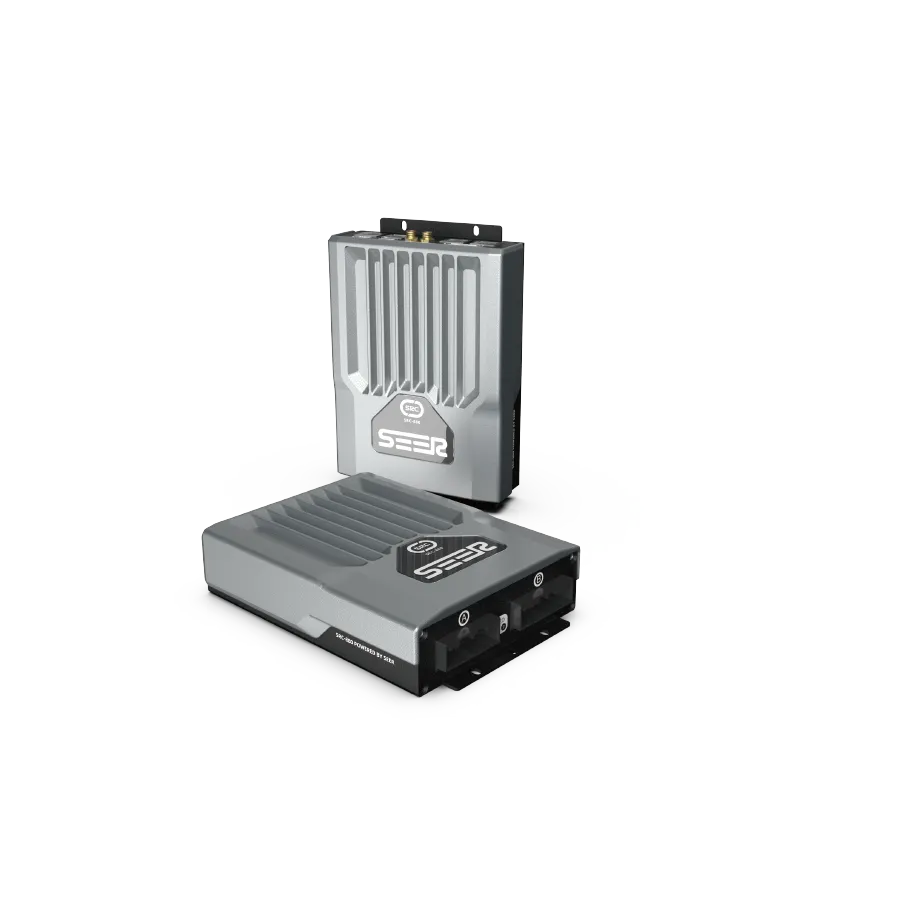
The nervous system is a unified interface and protocol stack that connects sensors, joints, and actuators. SEER Robotics' nervous layer is already compatible with more than 400 core components. This means one and the same brain can power a wide range of robot bodies — wheeled robots, tracked robots, robotic arms, and composite robots.
02 Why All Three Are Indispensable
With the model alone, instructions never reach the joints. With real-time control but no cognitive decision-making, the robot cannot understand the task. And when inference is pushed to the cloud, it cannot meet real-time and safety requirements, nor can it capture complete feedback from physical execution.
Perception → decision-making → execution → feedback must form a closed loop within a single system.
For a robot to complete a task end to end in the real world, all three layers must work as one.
03 The Robot Brain Is Neither a Domain Controller Nor a Model
Equating the robot brain with a domain controller underestimates it — a domain controller is merely an integrated board; it does not grow smarter as deployment volumes increase.
Equating the robot brain with a single model narrows its scope — a model only handles the "thinking," but completing real-world tasks also demands millisecond-level motion control and unified hardware interfaces.
If an analogy must be drawn from the automotive industry, our closest counterparts are not domain controllers but third-party autonomous-driving companies — what we deliver are systems and models, not an integrated circuit board.
SEER Robotics has ranked first in global robot brain shipments for three consecutive years, holding a 24.8% market share, and this business line has long maintained a gross margin above 80%. What underpins these results is years of accumulated expertise in algorithms, toolchains, and cross-configuration compatibility — not a bill of materials.
04 The Robot Brain: Infrastructure for the Embodied AI Industry
The more fragmented the robot bodies, the more valuable the brain — this is the fundamental difference between the robotics and automotive industries.
Why is an independent brain supplier particularly important in the robotics industry? The answer lies in a fundamental premise: robot bodies are destined to fragment, while the brain is destined to converge.
Even in the automotive industry, where a single model can sell over a million units, independent autonomous-driving companies remain essential. Robotics is far more diverse — wheeled robots, tracked robots, robotic arms, and composite robots — each produced in relatively small volumes. For every manufacturer to develop its own control software would be costly, slow, and ultimately shallow.
A standardized brain platform therefore becomes the industry's common denominator.
As more and more devices gain the ability to move and decide autonomously, a standardized brain platform will become the infrastructure on which the entire industry runs.
05 The Real Moat: The Real-Robot Data Flywheel
Real-world operating data flows back continuously from a unified controller foundation under consistent standards — data that is authentic, diverse, coherent, and self-renewing.
The core bottleneck of embodied AI lies in the brain, and the core bottleneck of the brain lies in real-robot data.
A domain controller does not grow smarter with scale; a robot brain does. Every robot operating in the real world contributes data to the brain, and every data point fed back makes the next robot smarter.
Closing Thoughts
A path more than a decade in the making, a future now accelerating.
SEER Robotics grew out of a robotics algorithm team at Zhejiang University that won the RoboCup World Championship three times. That algorithmic DNA has been embedded in the company since day one — and it has always operated in t
he physical world.
From algorithms to controllers, from brain platforms to data models, every step has been the entry ticket to the next stage.
When we speak of the "robot brain" today, we are speaking not merely of a product, but of a path forged over more than a decade.
While everyone debates when embodied AI will finally arrive, the question that truly matters is this: Whose brain is being used by more and more robots?


/1.png?x-oss-process=image/format,webp)
/1.png?x-oss-process=image/format,webp)
 Contact Us