
DATE: 2026/10/22
Fully Autonomous End-to-End! The Long-Horizon Embodied Intelligence Behind a Cup of Coffee
Removing the portafilter, catching the freshly ground coffee, distributing the grounds, tamping, locking the portafilter, placing the cup, initiating extraction, then serving the cup, clearing the spent puck, rinsing the portafilter, and returning every tool to its position—from brewing to cleanup, a single robot arm completes an entire cup of coffee autonomously.
This is the longest, most multi-step robotic coffee-making task SEER Robotics has demonstrated to date, requiring no human intervention at any point. Rather than fragmenting a complex workflow into isolated, disconnected motions, it preserves the complete process from preparation through brewing to cleanup.
Making coffee is not a simple stack of actions. Whether the portafilter is seated correctly, whether the grounds are evenly tamped, whether the cup sits in the right position—all of these factors affect the steps that follow. The robot must not only execute high-precision motions such as grasping, alignment, and tamping, but also continuously determine its next move based on task progress and the current scene.
This is a direct test of embodied intelligence's long-horizon task capability: chaining together a sequence of interdependent operations and executing them continuously from the first step to the last, rather than performing a single preset motion. The more steps involved, the more complex the transitions between changing task states and successive actions become.
Teaching the Model Through a Hands-On Practicum
Teaching a robot to make coffee is not about writing a dozens-of-pages instruction manual or hard-coding a fixed set of coordinates for every motion. SEER Robotics' approach is to feed the model learning material through operational demonstrations on real equipment—much like a barista's hands-on practicum.
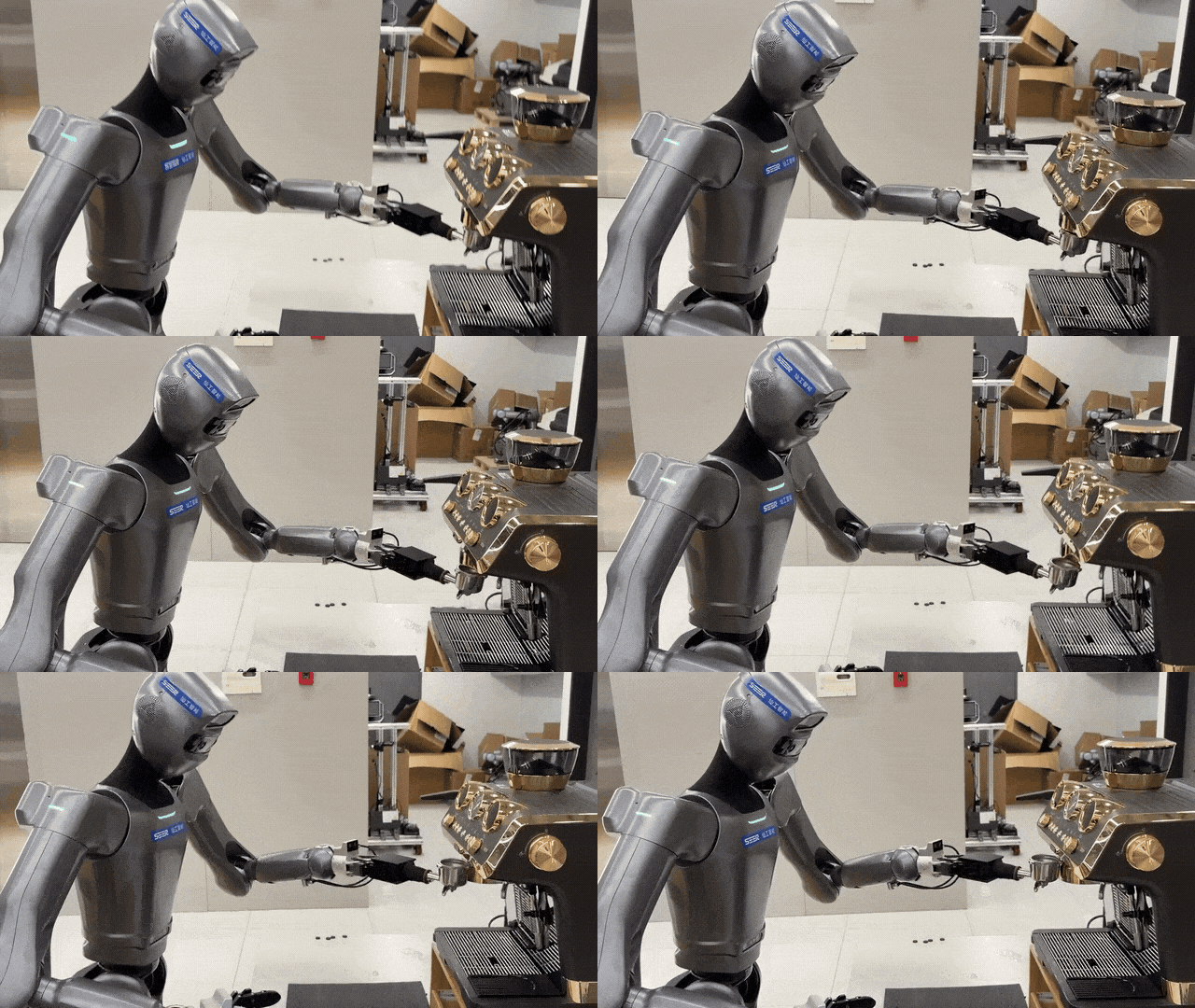
Demonstrations are first performed in front of a real espresso machine and its accessories. The system simultaneously records what the robot sees and how it should move—camera feeds, task instructions, robot arm positions, motion trajectories, and grasp-and-place actions—all of which become training data.
Building on this, SEER Robotics uses a small amount of real operational data to fine-tune its proprietary VLA (Vision-Language-Action) model, enabling it to output corresponding action decisions by combining the current visual scene with task requirements.
Once training is complete, repeated verification on real hardware is still required. What happens if the cup's position shifts? What if a tool is not perfectly aligned? Issues exposed during real-robot operation are used to supplement training data and iterate the model, gradually improving task execution capability.
The entire process can be summarized as: human demonstration → data collection → model training → real-robot testing → data supplementation → retraining.
Another notable aspect of this approach is the model's adaptability to real-world scene variations. The robot arm uses a general-purpose gripper rather than coffee-specific fixtures. When faced with coffee cups at different positions and heights, the model must re-perceive the scene and determine the appropriate action, rather than simply reproducing a fixed trajectory.
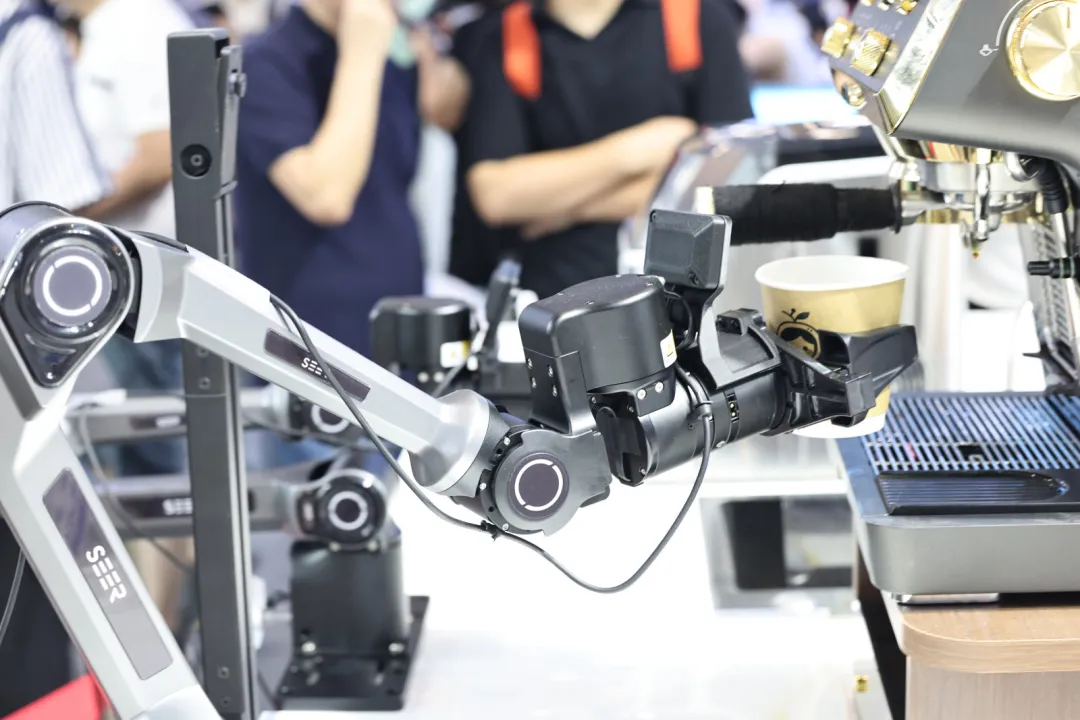
By learning from real operational data and then iterating through real-robot verification, the model gradually acquires the continuous decision-making and scene adaptation capabilities required to complete long-horizon tasks.
The Robot Brain: From Model Decisions to Real-World Robot Action
The key to completing a fully automated coffee-making task lies in the robot brain—the component that translates these decisions into real physical actions.
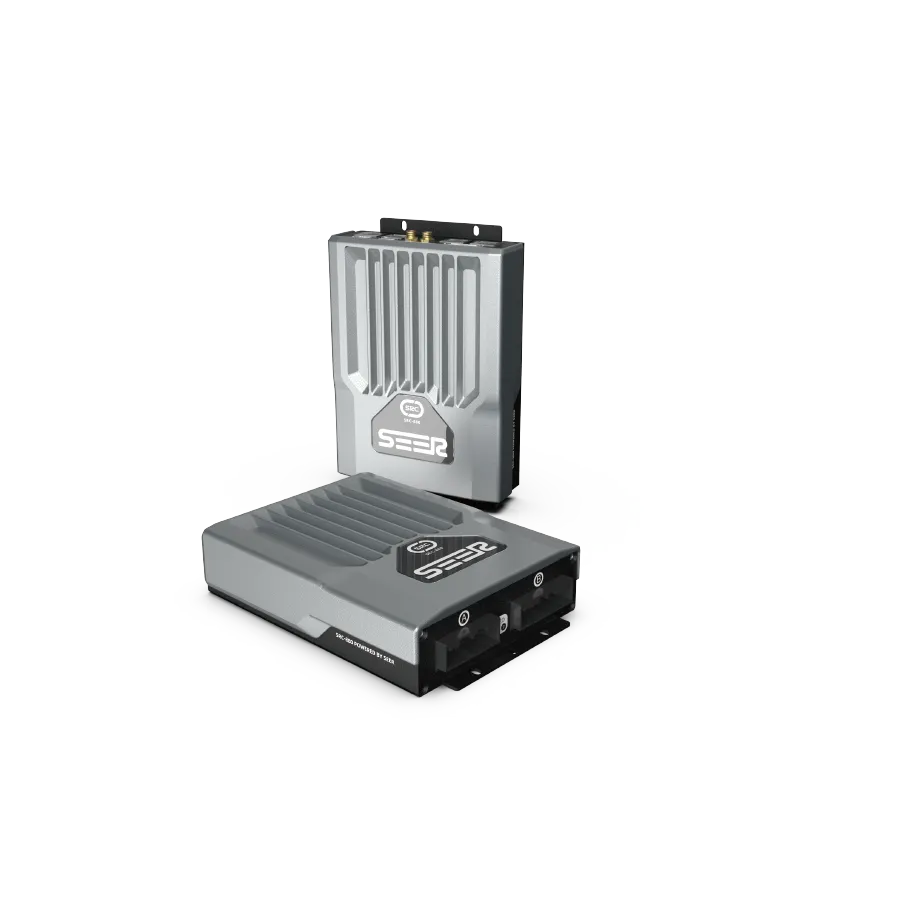
The SEER Robotics robot brain comprises three layers: the Model, the Cerebellum, and the Nervous System. The Model is responsible for understanding the scene, comprehending the task, and making decisions; the Cerebellum handles motion planning and action execution; the Nervous System connects sensors, joints, and actuators through unified interfaces and protocols. Working in concert, these three layers translate the model's decisions into coherent, precise physical operations by the robot arm.
A cup of coffee may seem mundane, but behind it lies a comprehensive test of long-horizon memory, high-precision manipulation, fully autonomous execution, and scene adaptation. From tamping and locking to extraction and cleaning, the coffee task demonstrates not merely how many motions a robot arm can perform, but how embodied intelligence connects scene understanding, continuous decision-making, and precise execution to complete an entire long-horizon task.
Moving from individual motions to complete tasks represents a critical step forward for embodied intelligence entering real-world service scenarios.




 Contact Us
