
DATE: 2026/10/19
Base Pushed, Discs Scrambled: How the Embodied Hanoi Tower Still Solves It Correctly
Three rods, three discs of varying sizes — a Hanoi Tower sits quietly on the demonstration platform.
Through its camera, the robotic arm observes the platform, grasps the discs, moves them into position, and adjusts each placement, transferring all three discs to the target rod step by step. The sequence spans seven consecutive moves; each one must obey the rules of the Hanoi Tower while meeting strict requirements for gripping position and motion precision.
Even when an observer slides the base to shift the tower’s overall position, or rearranges the discs into any arbitrary intermediate state, the robotic arm still recognizes the new configuration, determines the next move, and continues to complete the remaining task.
What appears to be a simple tabletop game is, in fact, a rigorous test of an embodied AI model’s logical reasoning and long-horizon memory, its fine-manipulation skills, and its ability to generalize when the environment changes.
From Understanding the State to Executing the Move
The rules of the Hanoi Tower are straightforward: transfer the discs of different sizes from one rod to another, moving only one disc at a time, and never placing a larger disc on top of a smaller one.
For a three-disc tower, the standard solution takes seven moves. The challenge is that the robotic arm cannot simply execute isolated picks; it must, across a continuously evolving state, reason out which disc to move at each step in order to complete the task.
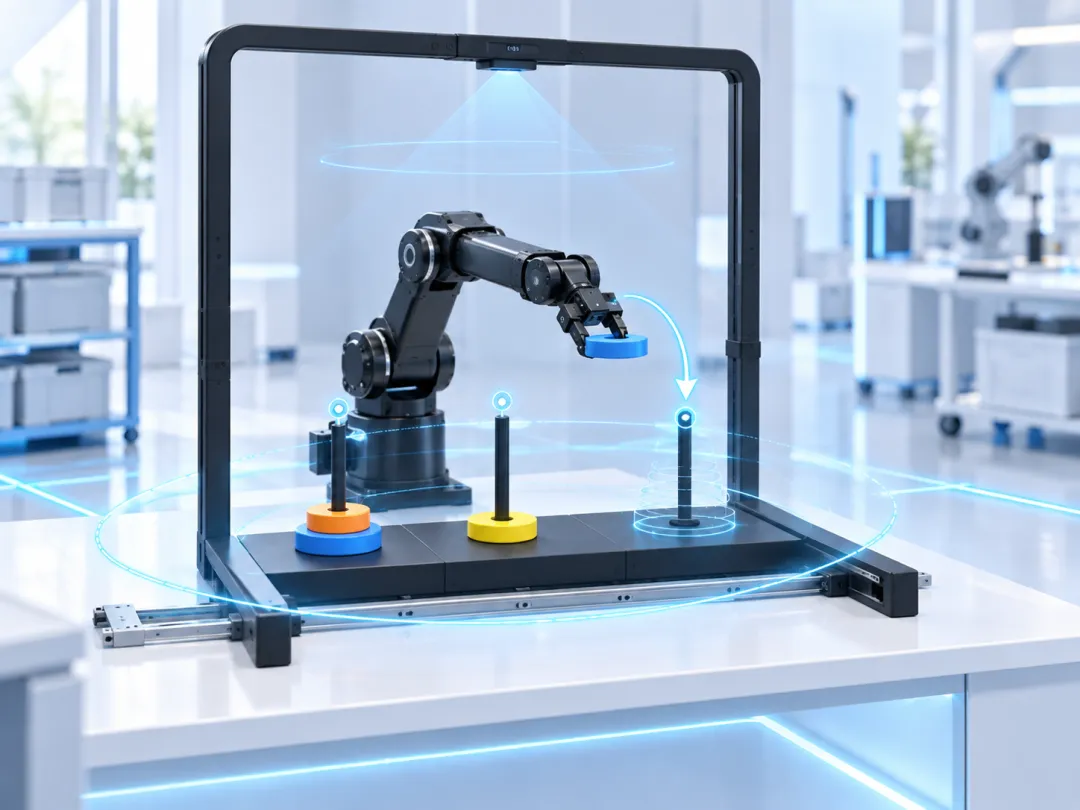
This requires the model to connect visual perception, task-level reasoning, and motion execution. The model captures the current scene through its camera, identifies the discs and their spatial relationships; together with the tower’s rules and the task goal, it reasons out the next move; and it then translates that decision into the arm’s grasping, moving, and placing actions.
After each move, the positions of the discs change, and the model must face a fresh scene and carry on with the next steps.
The leap from single-action execution to logical reasoning, long-horizon memory, and fine manipulation within a continuous task is the key technical highlight of this Hanoi Tower demonstration.
Interruptible, and Ready to Resume at Any Time
If the robotic arm only ever faced a tower at a fixed position and layout, task execution could rely on relatively stable operating conditions. In this demonstration, however, observers can step in at any moment and actively change those conditions.
Slide the base to shift the whole arrangement of discs and rods; place a disc already in the gripper back onto any rod, resetting the task to any state; or even swap in different component styles such as gold, silver, and bronze tokens or donut-shaped pieces.
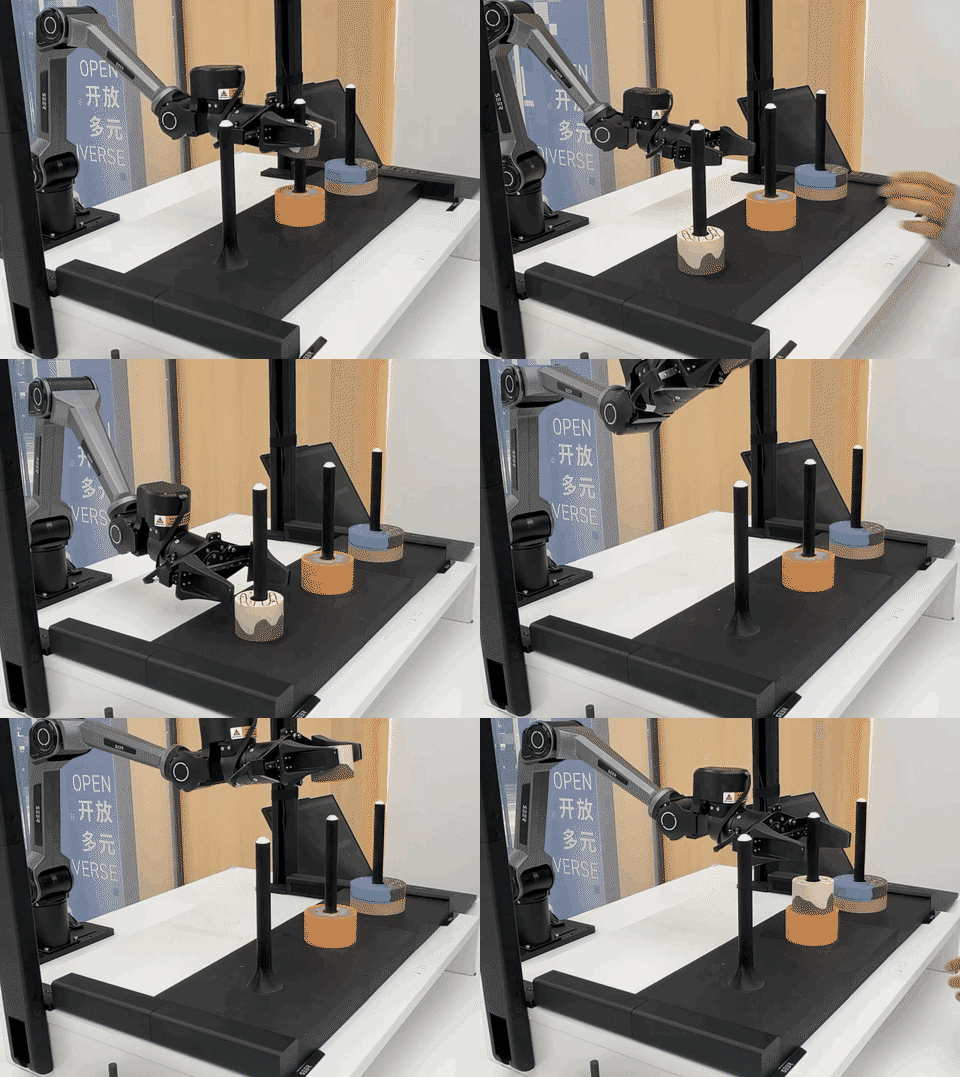
Faced with these changes, the robotic arm must re-perceive the current scene, determine the actual distribution of the discs, and adjust its next move accordingly — rather than blindly following an action sequence that no longer applies.
This tests not only the model’s understanding of task state but also its ability to generalize. Behind it lies SEER Robotics’ self-developed VLA model: trained on just 60 demonstration trajectories, it generalizes across object position, color, and shape — a reflection of the model’s foundational comprehension.
To translate model capability into real robotic operation, the robot’s “brain” must provide coordinated support. The SEER Robotics robot brain is composed of a model, a cerebellum, and nerves: the model understands the scene, grasps the task, and makes decisions; the cerebellum handles motion planning and execution; and the nerves connect sensors, joints, and actuators through unified interfaces and protocols. Working in concert, these three layers turn the model’s understanding and decisions into the arm’s physical actions.
From the Hanoi Tower to Real-World Business Scenarios
The Hanoi Tower is a task with well-defined rules, yet it concentrates several of the core challenges facing embodied intelligence: understanding real scenes, sustaining continuous reasoning, executing motions precisely, and adapting subsequent actions after the environment changes.
These capabilities are essential as robots move toward more complex real-world tasks. On actual industrial and commercial service floors, objects shift position, the items being handled differ, and task workflows must be adjusted. A robot must not only execute motions but also respond appropriately based on the state of the scene.
What the Hanoi Tower demonstration showcases is precisely the coordinated capability of the SEER Robotics robot brain — from scene understanding and task reasoning to motion execution. With the model, cerebellum, and nerves working together, a robot can not only carry out prescribed actions but also understand the task, adapt to change, and continuously improve through ongoing iteration in real-world settings.




 Contact Us
